By the beginning of 2026, the Telegram audience approached one billion users. There are over 15 million channels registered in the messenger, with thousands of new ones appearing daily. This means one of the most extensive and engaged advertising channels for businesses. The cost of placement ranges from 500 rubles for a post in a young channel to 500,000 rubles and higher in large thematic communities. But advertising in Telegram isn't just about posts from bloggers. Let's figure out what formats exist, how they differ, and how to choose the right one.
Advantages of Advertising in Telegram
Telegram gives advertisers access to an audience that spends a significant amount of time in the messenger. Users trust the content in channels, especially when presented as recommendations from the author. High engagement is confirmed by statistics: the average post reach in Telegram channels is 30-40% of the number of followers, and the click-through rate (CTR) for native ads can reach 2-5%, which is higher than in many other digital channels.
Additionally, Telegram offers flexible targeting options: you can target users by language, geolocation, device type, Premium subscription availability, and even by interests through channel themes. This allows you to precisely hit your target audience and spend your budget effectively.
Types of Advertising in Telegram: General Classification
All promotion methods in Telegram can be divided into two main groups: official (through the Telegram Ads platform) and unofficial (all others).
Within each group, there are specific subtypes, formats, and payment models.
By format:
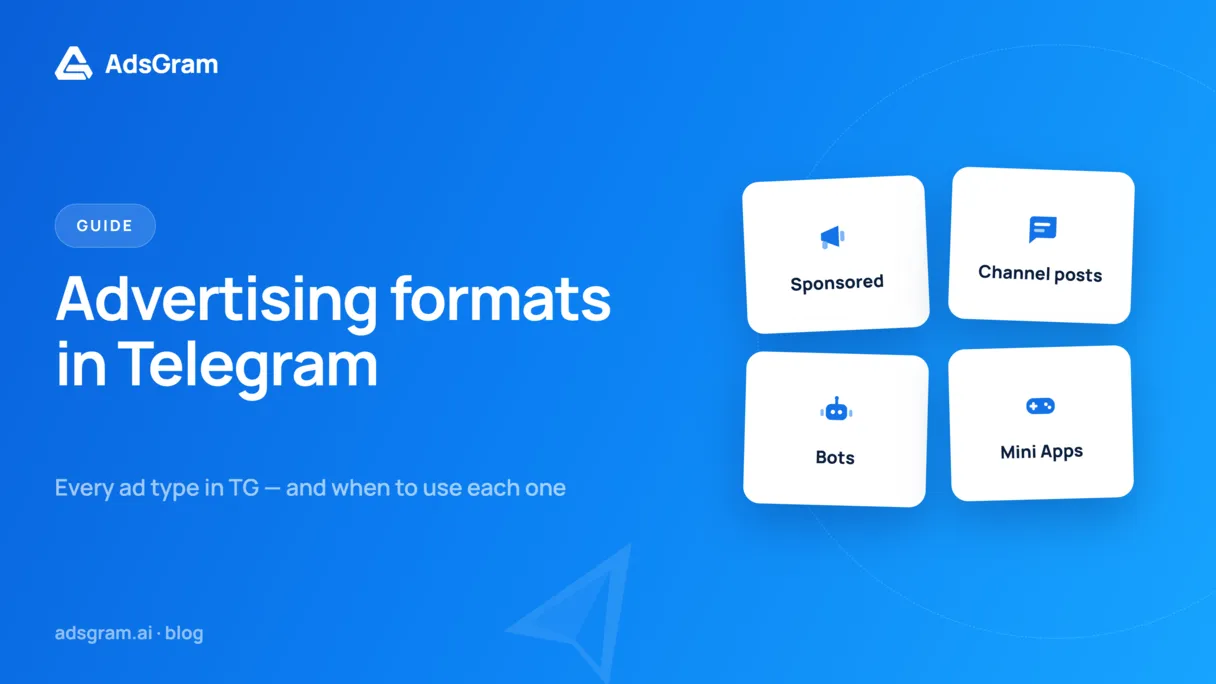
Text ads (up to 160 characters) are the foundation of Telegram Ads.
Media posts with images, videos, files — are placed through channel admins.
Ads in bots and Mini Apps — interactive formats that drive users to take action within the messenger.
Payment model:
CPM (cost per 1000 impressions) — common in Telegram Ads and advertising networks.
CPC (cost per click) — available in some networks.
Fixed fee per post — the classic approach to direct placements.
By organization method:
Official Telegram Ads platform.
Exchanges and channel catalogs.
Advertising networks (AdsGram and similar).
Direct agreements with channel owners.
Official Telegram Ads
Telegram Ads — covered in detail in our Telegram Ads guide — is an integrated advertising platform of the messenger launched in 2021. It allows displaying short text messages with links in channels with an audience of at least 1,000 subscribers. Ads appear like regular posts but are labeled as 'advertisement' and do not have reactions or comments.
How it works: The advertiser creates a campaign in the personal account, selects targeting settings (geo, language, channel topics, platform, Premium status), and sets a bid per thousand impressions. The system automatically allocates impressions in channels that meet the criteria. Payment is deducted as impressions are shown, and statistics are available in real-time.
Benefits:
Huge reach (all channels connected to monetization).
Guaranteed absence of fraud as traffic is controlled by Telegram.
Transparent statistics, precise targeting.
Cons:
High entry threshold — the minimum campaign budget is several thousand euros.
Limited format — text only, no images or videos.
Lengthy moderation and strict rules.
Unofficial placement methods
Unofficial methods include all options that do not use the official Telegram ad cabinet. They are divided into several categories.
Exchanges and channel directories
Services like Telega.in, Sociate, Tgram.ru allow you to search for channels by topic, post price, and statistics. Advertisers choose platforms, negotiate with administrators through the exchange or directly, and pay for placement. Exchanges often take a commission and provide guarantees (for example, a refund in case of underdelivery).
This is convenient for one-off campaigns, but requires manual selection and monitoring.
Agencies
Professional intermediaries take care of channel selection, negotiations, placement, and reporting. This saves time, but increases the budget due to agency fees. It is suitable for large advertisers launching regular campaigns.
Direct contacts with administrators
The oldest way is to reach out directly to the channel owner and negotiate a post. Downsides: the labor-intensive search, the risk of encountering unscrupulous admins, lack of guarantees. Upsides: the ability to bargain and flexibly discuss terms.
Advertising networks
These are automated platforms that bring together numerous channels, bots, and Mini Apps. Advertisers run campaigns from a single dashboard, and the network distributes impressions across its platforms. Payments are usually made for impressions or clicks. An example of such a network is AdsGram.
AdsGram: an alternative to official Telegram Ads
AdsGram is an advertising network operating within Telegram. It is not an exchange where you buy a specific post from a particular author. Here, advertisers purchase managed traffic: the system automatically selects inventory (channels, bots, Mini Apps) based on specified parameters and displays ads in the required format.
How AdsGram differs from Telegram Ads:
Lower entry threshold — you can start with a small budget, testing hypotheses without significant investments.
A variety of formats: not only text ads are available, but also media posts with images, videos, and buttons.
The possibility to advertise in bots and Mini Apps, providing additional touchpoints with the audience.
Flexible payment models: CPM or CPC, allowing advertisers to choose their strategy.
Targeting by language, geo, topic, platform, availability of Telegram Premium, and even by Wallet owners (cryptowallet within Telegram).
How AdsGram works:Advertisers register in the dashboard, create a campaign, upload creatives, configure targeting and budget. The platform's algorithms distribute impressions across all connected sites, filtering out fraud and ineffective placements. All metrics are visible in the statistics: reach, clicks, CTR, spend. You can quickly change bids, stop underperforming ads, and scale successful ones.
For channel owners, bots, and Mini Apps, AdsGram is a way to monetize their audience and earn stable income from ad impressions. The platform handles finding advertisers and technical integration.
Conclusion
The advertising market in Telegram is diverse and offers solutions for any budget and goals. Official Telegram Ads is suitable for large companies with high budgets that require guaranteed quality traffic and scalability.
Unofficial methods — exchanges, direct placements, and native advertising in TG — allow flexible work with niche audiences but require manual effort and attention to detail.
Advertising networks like AdsGram occupy an intermediate position: they automate the process, lower the entry threshold, and expand opportunities through unconventional formats (bots, Mini Apps). For small and medium businesses, startups, and performance agencies, this is often the optimal choice: campaigns can be quickly launched, hypotheses tested, and measurable results obtained.
The choice of approach depends on your goals, budget, and willingness to dive into the routine. But regardless of the chosen path, Telegram remains one of the most promising channels for attracting a target audience.