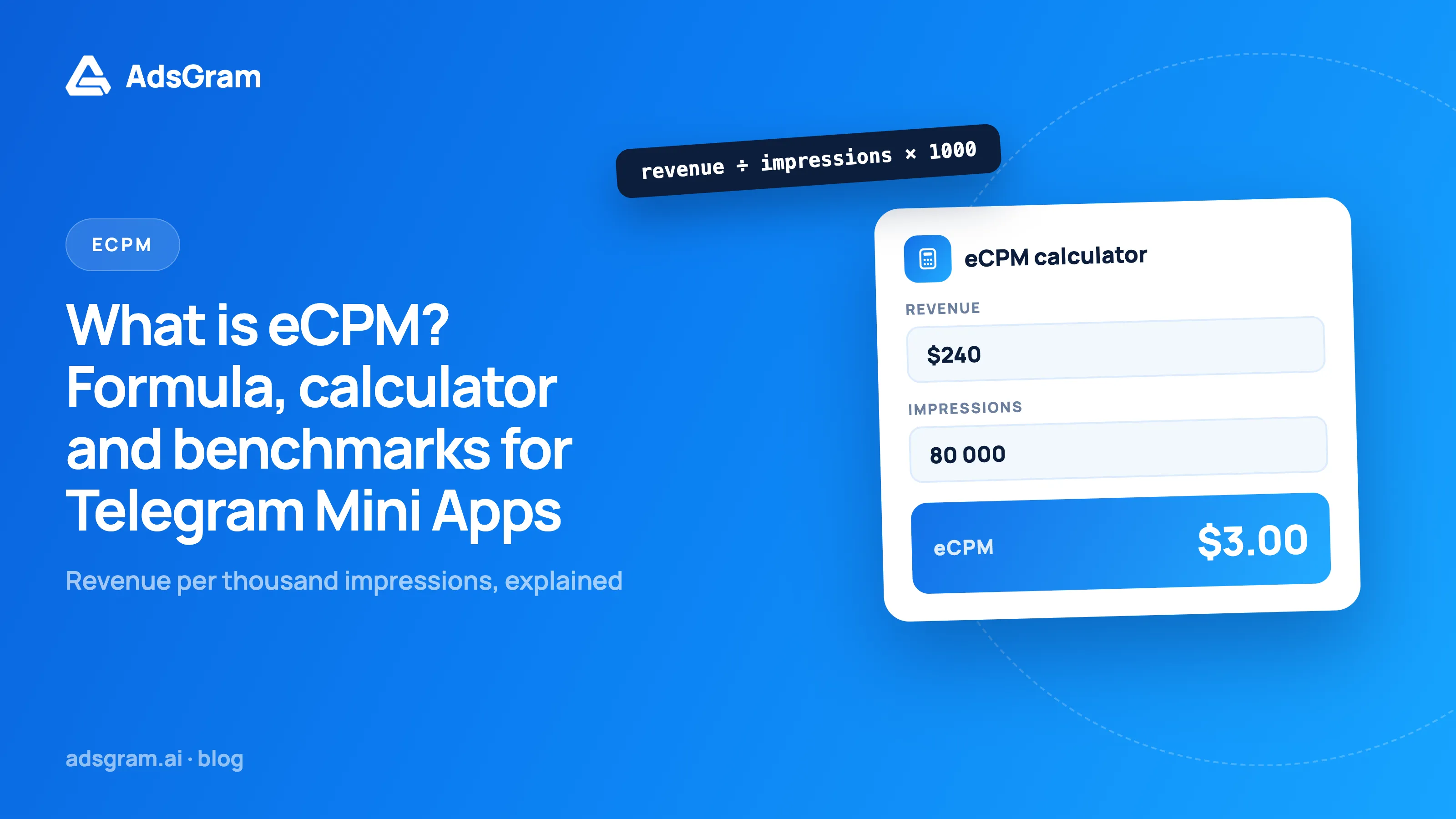
The cost of effective Telegram advertising with influencers varies widely. Depending on the niche, quality channels with active audiences offer CPM rates from 300 to 1500 rubles for 1000 impressions. For example, in entertainment niches, the price is often lower—around 300–600 rubles, whereas in finance, IT, or business, CPM can start from 800–1000 rubles and reach up to 2000 rubles for a thousand impressions.
For a test campaign that allows you to gather initial data and assess audience response, a budget of 15,000 to 30,000 rubles is usually allocated. This is sufficient to launch on 3–5 channels or through a marketplace for influencers in TG and understand which platforms deliver results and where you are simply wasting your budget.
Why influencer advertising on Telegram is effective
Telegram remains one of the few platforms where there is a high level of trust among subscribers in the author's opinion. People join channels for expertise, humor, or news and perceive the influencer as a friend or a respected expert. Integration in this context works more softly and effectively than direct banner advertising.
Additionally, Telegram offers a long lifespan for posts. Unlike Instagram Stories, which disappear after a day, or TikTok feeds, where a video lasts only a few hours, a post in a channel can generate impressions for days or even weeks. The audience here is more active in clicking links and tends to read texts to the end, especially if they are written in the influencer's native style.
However, high effectiveness is only possible under one condition: you have correctly chosen the channel and the blog's audience matches your customer profile.
What to consider when choosing a channel for advertising
Before allocating a budget to the owner of a popular channel, it’s necessary to check several parameters. A mistake at this stage leads to wasted money and disappointment with the channel.
Niche of the platform.If you sell equipment for restaurants, advertising in a channel about knitting will yield zero results. The audience must overlap with your business. Look for blogs where subscribers are already interested in your field.
Quality of the audience.A huge channel with 500,000 subscribers can be worthless if it's filled with fake bots. Here's what to look for:
Post views should be proportional to subscribers. A normal reach for posts on Telegram is 10-20% of the total audience. If the channel has 100,000 people, but posts gather 1,000-2,000 views, 95% of the audience is dead.
Activity in comments and chats. Real people argue, ask questions, and react.
Growth dynamics. Sudden spikes in subscribers in the past (on TGStat graphs) often indicate bot purchases.
Adequacy of CPM.Too cheap placement (for example, 200 rubles for 1000 impressions in a business niche) usually means you are either dealing with a scammer or a bot channel. Placement that is too expensive (twice the market rate) does not guarantee results but merely increases the cost of your inquiry.
How to search for channels and bloggers
There are three fundamentally different approaches to searching: manual, through exchanges, and using automated services. Let's take a closer look at each.
Manual Search
The oldest and most labor-intensive method. You search for platforms yourself through Telegram search, directories like TGStat, or simply by checking who is advertising with your competitors.
How it works:
- You compile a list of keywords related to your niche.
- You enter them in the Telegram search and look for channels.
- You visit each channel, study the posts, and observe the activity.
- You look for the owner's contact information (usually in the description or through a feedback bot).
- You write to each one manually, negotiate the price, wait for responses, pay, and receive screenshots of the statistics.
Pros:Free to find unique niche channels that are not represented on exchanges.
Cons:Huge time investments, high risk of encountering scammers, difficult to verify actual statistics, no guarantees for placement. This approach works poorly for systematic efforts.
Bloggers Exchange on TG
Exchanges are platforms that gather thousands of channels in one place and provide advertisers with tools for selection and launching. This is the next level after manual searching.
How the bloggers exchange on TG works:
- You enter the platform (for example, Telega.in, Sociate, PRCY).
- Set filters: topic, number of subscribers, placement cost, language, geo.
- Receive a list of suitable channels with transparent statistics (CPM, reach, ER).
- Choose the platforms you like, pay for placement through the service.
- The post is published automatically or after admin approval.
Advantages: Time savings, transparent pricing, verified statistics (exchanges filter out blatantly inflated channels), secure payment.
Disadvantages: Higher competition for top positions, platform commission, the selection is still limited to channels registered on the exchange.
For those who want to buy integrations regularly and manage the process centrally, the blogger exchange on TG is the optimal choice. But even here, you are still purchasing a specific spot from a specific person.
Services and directories
TGStat and similar services are analytical tools. They are not intended for direct purchases, but are great for reconnaissance. You can find channels by keywords, track their growth dynamics, and see what ads they published before. This is useful as a supplement to manual searches or exchanges, but as a standalone tool for regular placements, it is inconvenient.
How to simplify ad placement on TG
All the methods described above have one thing in common: you search for a channel, negotiate with its owner, and pay for a specific post. It works, but requires manual management and does not allow for rapid scaling.
Advertising networks like AdsGram offer an alternative approach. This is not a classic blogger exchange on TG; rather, it's an advertising platform that operates on the principle of performance marketing. Here, you don't buy a 'post from a blogger' but a managed stream of traffic targeted at your audience.
How it works:
- You create a campaign in your AdsGram personal account.
- Upload your creative (post text, image, link).
- Set up targeting: choose the theme, audience interests, geo, language, device type, Telegram Premium subscribers.
- Set your bid (CPM — for impressions or CPC — for clicks) and budget.
- The system automatically distributes your ads across thousands of Telegram channels, bots, and Mini Apps connected to the platform.
The main difference from an exchange: you don't manually select channels. AdsGram's algorithms find the platforms where your ads will perform best and continuously optimize impressions by filtering out fraud and non-targeted traffic.
This approach is ideal for businesses that need specific actions — applications, registrations, sales, not just views. You don’t have to spend weeks negotiating with dozens of admins. You launch a campaign, receive transparent real-time statistics, and scale what delivers results.
Manual search and exchanges are good for targeted integrations with specific bloggers when the author's voice is crucial — see native advertising examples for what those integrations typically look like. For systematic customer acquisition with predictable contact costs, it's more effective to use advertising networks.
Conclusion
There are various ways to find bloggers for advertising on Telegram. Manual searches provide freedom but consume time and involve risks. Blogging exchanges in TG streamline the process and make it more transparent. Advertising networks like AdsGram allow you to focus entirely on results—leads and sales—without worrying about finding specific individuals.
The choice of tool depends on your objective. If you need a one-time mention from a specific author, go for an exchange or contact the admin directly. If you need a steady stream of clients, test out automated platforms. The key is to always check audience quality and rely on numbers, not just on big names.