In-app advertising pays for most of the free apps, games and messenger Mini Apps people use every day. For a developer it is the shortest route from an audience to recurring revenue; for an advertiser it is a way to reach people at the moment they are most engaged with a screen.
This guide explains what in app advertising is and how it works on both sides of the deal, which formats exist and what they look like in practice, how much revenue apps make from ads (with benchmarks and a worked forecast), what advertisers pay, and which trends will shape budgets in 2026. The definition comes first, because the revenue math only makes sense once the mechanics are clear.
TL;DR
- In-app advertising is the placement of ads inside mobile applications, games and app-like environments such as Telegram Mini Apps, sold mainly on a CPM basis.
- The main in-app ad formats are rewarded video, interstitial, banner, native and task-based ads; rewarded video earns the highest eCPM, banners the lowest.
- How much revenue an app makes depends on three inputs — daily active users, ad impressions per user and eCPM — and eCPM is driven mostly by audience geo and format.
- Advertisers buy in-app placements on CPM, CPC or CPA pricing with targeting by geo, language and device; costs rise with Tier-1 audiences and premium formats.
- Juniper Research forecast mobile in-app ad spend at $425 billion in 2026, more than half of all digital advertising.
What Is In-App Advertising
In-app advertising is the delivery of paid ads inside a mobile application rather than on a website or in a browser. The app owner (the publisher) sells screen space; the brand or performance buyer (the advertiser) pays to show its creative to the app's users; an ad network or platform sits between them, collecting demand, matching it to inventory, filtering fraud and paying out revenue.
Mobile app advertising is a broader term that also covers ads for apps, such as install campaigns on social media. Here the focus is ads inside apps, which is what "in-app" means in industry usage.
The channel is large. Juniper Research forecast that mobile in-app advertising spend would reach $425 billion in 2026, or 56% of global digital ad spend, against $142 billion for desktop.
How In-App Advertising Works
In-app advertising works through an ad request, a matching step and a paid impression: the app asks a network for an ad, the network returns the best-paying creative, and the publisher earns a share of what the advertiser paid. The full loop:
- Integration. The publisher adds the network's SDK (native apps) or a JavaScript/API integration (web apps and Mini Apps) and creates ad blocks — placements with their own IDs and statistics.
- Ad request. When the user reaches a placement (level end, "Earn" screen, app open), the app requests an ad.
- Matching. The network selects a campaign whose targeting fits the user: geo, language, device, sometimes Premium status or VPN use.
- Impression and event. The ad is shown; the network logs the impression, any click and — for rewarded or task formats — the completed action.
- Billing and payout. The advertiser is charged on the campaign's pricing model (CPM, CPC or CPA). The publisher accrues revenue per 1,000 impressions and withdraws it once a threshold is reached.
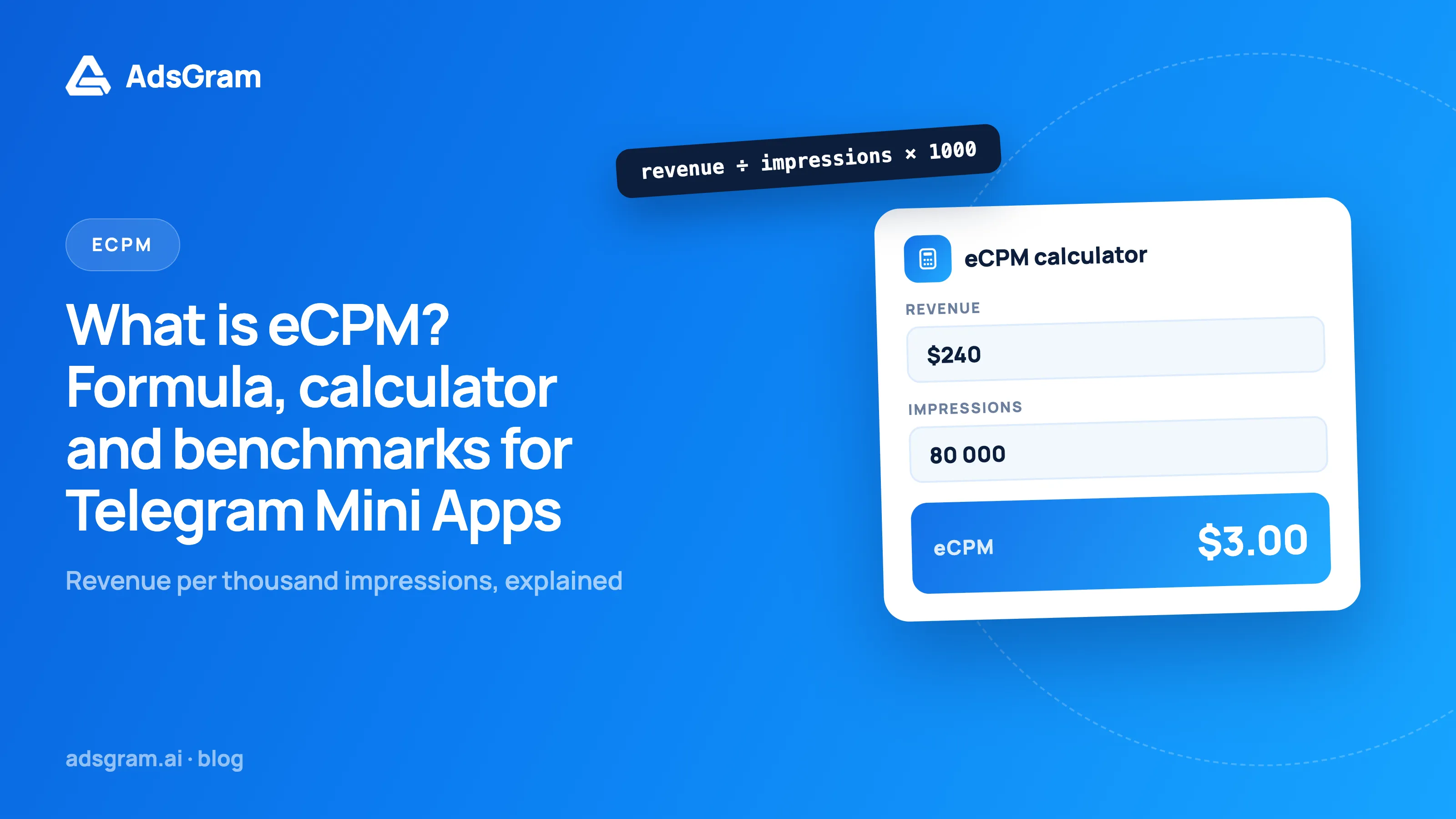
Two terms you will meet constantly: CPM (cost per mille) is what an advertiser pays for 1,000 impressions; eCPM (effective cost per mille) is what a publisher actually earns per 1,000 impressions after network commission and filtered traffic. The two are never equal.
In the AdsGram network, for example, a Mini App publisher earns per 1,000 impressions at a rate that depends on the user's geo, while advertisers choose between CPM, target CPC (tCPC) and target CPA (tCPA) when setting up a campaign.
In-App Advertising Formats and Examples
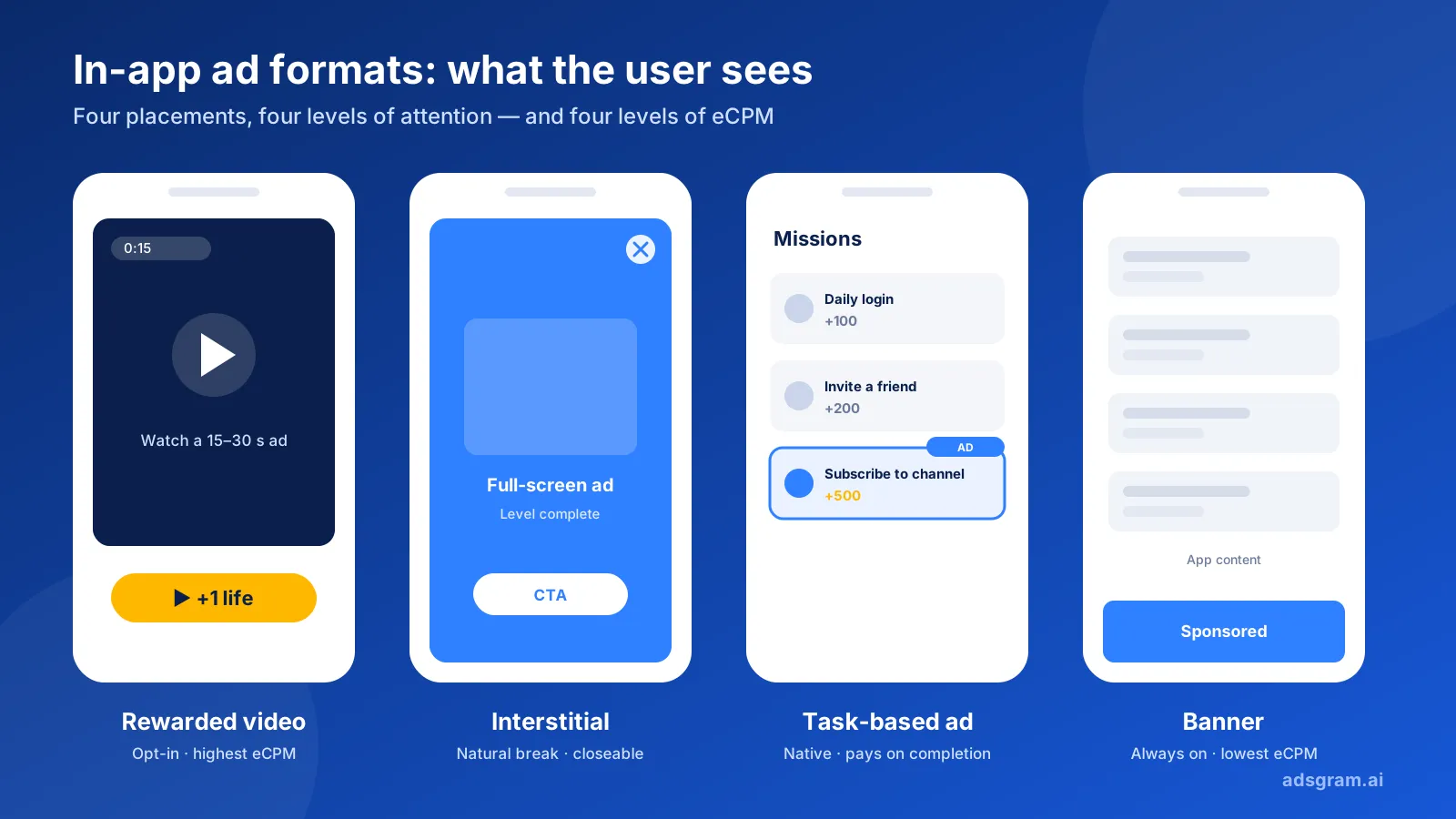
The five standard in-app advertising formats are rewarded video, interstitial, banner, native and task-based ads, and they differ mainly in how much of the user's attention they ask for. Google's AdMob documentation describes the core set — banner, interstitial, rewarded and native — as distinct ad formats, each suited to different ad types.
Format | What the user sees | Best fit | Revenue level |
|---|---|---|---|
Rewarded video | Opt-in 15–30 s video; user gets a bonus (life, booster, currency) | Games, tap-to-earn, utilities with a reward loop | Highest eCPM |
Interstitial | Full-screen image or video at a natural break; closeable | Level transitions, screen changes | High, volume-driven |
Task-based ad | Native item in a "Missions" list: subscribe, open an app, complete an action | Apps with a quest or earn screen | Medium–high, pays on completion |
Native ad | Styled like app content: a post, a card, a chat message | Feeds, bots, content apps | Medium, depends on blend |
Banner | Small static block at the top or bottom of the screen | Content apps with long sessions | Lowest eCPM |
Concrete in-app advertising examples:
- Rewarded video in a game. In the Bcoin2048 Mini App, the player receives a booster for watching a video ad — a documented AdsGram integration and the classic rewarded exchange.
- Interstitial between levels. A puzzle game shows one full-screen ad after every third level, with a close button, so sessions are never interrupted twice in a row.
- Task-based ad in an earn screen. A tap-to-earn app lists "Subscribe to channel X — +500 coins" next to its own missions; the reward is verified server-side.
The in-app channel is no longer limited to app-store apps. Telegram Mini Apps, bots and channels form an in-app environment of their own, with the same rewarded, interstitial and task formats, and a Telegram advertising platform such as AdsGram sells those placements to advertisers the way a mobile ad network sells app-store inventory.
How Much Revenue Apps Make From Ads
How much revenue an app makes from in-app advertising is the product of three numbers: daily active users, ad impressions per user and eCPM. Everything else — formats, geos, placements — moves one of those three.
Daily revenue = DAU × impressions per DAU × eCPM ÷ 1,000
The variable most people underestimate is eCPM. Appodeal's eCPM Report 2025, based on more than 200 billion ad views, found that rewarded video had the highest eCPM on both iOS and Android, interstitials grew steadily, banners stayed the lowest-earning format, and North America and Europe led on rates. These are mobile-app benchmarks rather than Telegram-specific ones, but the ordering holds across platforms:
Format | Tier 1 (US, UK, DE, AU, KR, AE) | Tier 2 (Eastern Europe, LATAM leaders, Türkiye) | Tier 3 (South Asia, SE Asia, Africa) |
|---|---|---|---|
Rewarded video | roughly $10–20+ | roughly $3–8 | roughly $1–3 |
Interstitial | roughly $5–12 | roughly $1.5–4 | roughly $0.3–1.5 |
Banner | roughly $0.3–1 | roughly $0.1–0.3 | under $0.1 |
A worked example (illustrative figures): a casual Mini App with 15,000 DAU shows 1 rewarded and 2 interstitial ads per user per day. With a Tier-2-heavy audience, suppose rewarded earns $4.00 eCPM and interstitial $1.50.
- Rewarded: 15,000 × 1 × $4.00 ÷ 1,000 = $60 per day
- Interstitial: 15,000 × 2 × $1.50 ÷ 1,000 = $45 per day
- Total: $105 per day, about $3,150 per month, at a blended eCPM of $2.33
Shift the same users to a Tier-1 geo mix and the figure grows several times without a single new install. That is why mature publishers track eCPM per ad block and per country rather than one app-wide number; the AdsGram guide to the eCPM formula and Mini App benchmarks walks through three such scenarios step by step.
For publishers in the Telegram ecosystem, the AdsGram platform pays revenue in USDT on the TON network with a standard minimum of $100, and the dashboard reports impressions, clicks and revenue per ad block. Current formats and connection steps are on the Telegram Mini Apps monetization page.
In-App Advertising Cost and Rates for Advertisers
In-app advertising cost for an advertiser is set by the pricing model, the targeting and the format: CPM for reach, CPC for traffic, CPA for actions, with Tier-1 geos and rewarded or video formats at the top of the price range. The eCPM table above is, in effect, the price map an advertiser pays into.
What drives rates:
- Geo and language. A US or German audience costs several times more per 1,000 impressions than a South Asian one.
- Format. Rewarded and video placements are priced above static interstitials and banners because completion and attention are higher.
- Targeting depth. Narrower segments (device, Premium status, VPN exclusion) raise the effective price but improve conversion.
- Pricing model. CPM is cheapest per impression but carries the conversion risk; tCPC and tCPA shift that risk toward the platform and require conversion tracking — in AdsGram, tCPA is available once a postback is configured.
On the AdsGram platform, an advertiser can launch a campaign in Telegram channels, bots and Mini Apps in about five minutes, choose CPM, tCPC or tCPA, target by geo, language, device, VPN status and Telegram Premium, and track results through AppsFlyer, Adjust, AppMetrica, Keitaro or Kochava. AdsGram is also an official Telegram Ads reseller, so brands that want Telegram's native ad inventory can run it from the same account. If you buy in-app traffic to feed an offer, the AdsGram guide to mobile traffic arbitrage covers the economics on the buying side.
In-App Advertising Best Practices
The best practices for in-app advertising all point in one direction: sell attention the user is willing to give, at moments that do not break the product. This checklist separates apps earning $1 eCPM from apps earning $5 on the same traffic:
- Lead with rewarded formats. Put the reward where it has real value in your economy — an extra life, a 2× booster, a second spin. A reward nobody wants produces impressions nobody pays well for.
- Cap interstitials. Two to three per session at natural breaks is a sensible start. Never show one while the user is mid-action.
- Place task ads inside your missions list. They convert when they look like part of the product, not like a pop-up.
- Create one ad block per placement. Separate statistics are the only way to see which placement earns $8 eCPM and which earns $2.
- Verify rewards server-side. Fraudulent "completions" inflate impressions without adding revenue.
- Give new placements two to three weeks before judging them — eCPM usually rises once the network has data on your audience.
For advertisers the mirror rule applies: match the creative to the format (a 15-second vertical video for rewarded, a single-message visual for interstitials, a one-line benefit for task ads), start on CPM to learn the audience, then move to tCPC or tCPA once conversion data flows.
In-App Advertising Trends in 2026
The in-app advertising trends that matter in 2026 are privacy-driven attribution, the continued lead of rewarded formats, and the growth of app-like environments outside the app stores. Each one changes how revenue is earned or how campaigns are measured.
- Privacy-first measurement. Apple's App Tracking Transparency and SKAdNetwork, together with Google's Privacy Sandbox on Android, limit cross-app tracking. Advertisers rely more on MMP postbacks (AppsFlyer, Adjust, Kochava) and contextual targeting — geo, language, device — than on user-level identifiers.
- Rewarded formats keep the lead. Opt-in formats earn the most per impression in every recent benchmark, so publishers move volume toward them instead of adding interstitials.
- Super-app and messenger inventory. Mini Apps inside Telegram, mini-programs in Asian super-apps and web games reach large audiences without an app-store install, opening a new in-app channel for publishers and advertisers alike.
- Anti-fraud as a selling point. Networks that filter invalid traffic 24/7 win advertiser trust and, in turn, pay publishers more reliably.
For a developer the practical conclusion is simple: the channel is growing, the highest-paying formats are the ones users choose to watch, and the right time to connect an ad network is before the next traffic spike, not after it. If you are comparing networks, the AdsGram breakdown of ad formats, requirements and payouts for publishers is a useful starting point.
FAQ
- What is in-app advertising?
In-app advertising is the placement of paid ads inside a mobile application, game or app-like environment such as a Telegram Mini App, rather than on a website. The app owner sells placements, an advertiser pays to show creatives, and an ad network matches the two, filters fraud and handles payouts. It is the main revenue model for free apps and games. - How does in-app advertising work?
In-app advertising works through an ad request and a paid impression. The publisher integrates an SDK or API and creates ad blocks; when a user reaches a placement, the app requests an ad; the network picks a campaign whose targeting matches the user; the impression, click or completed action is logged. The advertiser is billed on CPM, CPC or CPA, and the publisher earns per 1,000 impressions. - What are the main in-app advertising formats?
The main in-app advertising formats are rewarded video, interstitial, banner, native and task-based ads. Rewarded video is opt-in and pays the highest eCPM; interstitials are full-screen ads at natural breaks; task-based ads reward an action such as subscribing to a channel; native ads mimic app content; banners are small static blocks with the lowest rates. - How much revenue do apps make from in-app ads?
Revenue from in-app ads equals daily active users × impressions per user × eCPM ÷ 1,000. A Mini App with 15,000 DAU showing three ads per user at a blended $2.33 eCPM earns roughly $105 per day (illustrative). Rewarded video in Tier-1 markets reaches $10–20+ eCPM, while interstitials in Tier-3 markets can earn under $1, so geo mix and format decide the outcome. - How much does in-app advertising cost for advertisers?
In-app advertising cost depends on pricing model, geo, format and targeting. CPM is the base model, with Tier-1 audiences and rewarded or video formats priced highest; CPC and CPA pricing shifts conversion risk to the platform and requires tracking. On the AdsGram platform advertisers choose CPM, tCPC or tCPA and target by geo, language, device, VPN status and Telegram Premium. - Which in-app advertising format earns the most?
Rewarded video earns the most per impression. Appodeal's eCPM Report 2025 found it had the highest eCPM on both iOS and Android, ahead of interstitials, with banners the lowest. Because users opt in, completion and attention are high and advertisers pay a premium. Task-based ads that pay on completion are the closest equivalent for apps with a missions screen.