TL;DR
- Traffic arbitrage is a performance marketing model in which you buy ad traffic with your own money and get paid for the actions that traffic produces. Profit is the gap between payouts and ad spend.
- Every setup has three parties besides the buyer: a traffic source that sells impressions or clicks, an offer that pays for a result, and an affiliate network that connects the two and handles payouts.
- Affiliates are usually paid by CPA, CPL or RevShare, while traffic is bought by CPM or CPC. The core skill is keeping earnings per click above cost per click.
- A first test needs a traffic budget, a tracker and a reserve for failed tests. In the AdsGram network there is no minimum deposit, and AdsGram recommends 100–250 USDT for a meaningful first test.
- The main risks are untested funnels, rejected leads, payout holds and account bans on strictly moderated platforms. Tracking, a stop-loss and compliant creatives keep them under control.
Advertisers keep moving budgets into channels where they pay for results: eMarketer expects US affiliate marketing spend to grow 11.4% in 2026. Part of that money is earned by independent media buyers who pay for ads themselves and keep the difference.
This guide covers the whole topic from the ground up. You will learn what the model is, how the source–offer–network scheme works, which payout models and traffic sources exist (including Telegram and Telegram Mini Apps), how much you need to start, what you can realistically earn, and where beginners lose money. A glossary and an FAQ close the article. We start with the definition, because many early losses come from treating arbitrage like ordinary advertising.
What is traffic arbitrage
Traffic arbitrage is buying advertising traffic at one price and earning more from the actions that traffic produces. A media buyer pays an ad platform for impressions or clicks, sends those users to an advertiser's offer, and receives a payout for each registration, install, lead or sale.
The word comes from finance: buy in one market, sell in another, keep the spread. Here the two markets are ad inventory and customer acquisition. That is the full traffic arbitrage meaning. Everything else is execution.
Three things separate it from regular advertising:
- Whose money is at risk. An in-house marketer spends the company's budget. An arbitrageur spends their own and is paid only for results.
- What is being sold. Not a product, but a conversion delivered to someone else's product.
- How success is measured. By ROI on each funnel, not by reach or brand metrics.
Types of traffic arbitrage
The term covers several business models. They share the same logic and differ in where the revenue comes from.
Type | What you buy | How you earn | Main constraint |
|---|---|---|---|
Affiliate arbitrage | Paid traffic to an advertiser's offer | Payout from an affiliate network (CPA, CPL, RevShare) | Approval rate and payout hold |
Ad arbitrage, including AdSense arbitrage | Cheap paid visits to your own content site | Display ad revenue per session | Publisher policies on ad-first pages |
Search arbitrage | Social or native traffic to a search results page | A share of revenue from search ads clicked on that page | Compliance rules of the search feed provider |
Media arbitrage | Ad inventory in bulk or at a fixed rate | Reselling the same inventory at a markup | Fill rate and inventory quality |
In-app and Mini App arbitrage | Installs or new users for your own app | In-app ad revenue and purchases over the user's lifetime | LTV must exceed the cost per user |
A few notes on the less obvious rows:
- Ad arbitrage leaves the least room for error. Google Ads disapproves destinations built primarily to show ads, and the AdSense Program policies do not allow ads on pages published specifically for that purpose. The model works only where the content has real value.
- A search arbitrage media buyer does one thing: buys clicks for less than the search feed pays for them. The skills are the same as in affiliate work, but the "offer" is a results page.
- Mini App arbitrage is the Telegram version of the in-app model. You acquire users for your own Mini App and earn from rewarded video, interstitial and task ads. AdsGram covers both sides: user acquisition for advertisers and ad monetization for publishers.
The rest of this guide focuses on affiliate arbitrage, the most common entry point. The mobile-only variant has its own specifics, covered in our guide to mobile traffic arbitrage.
How traffic arbitrage works
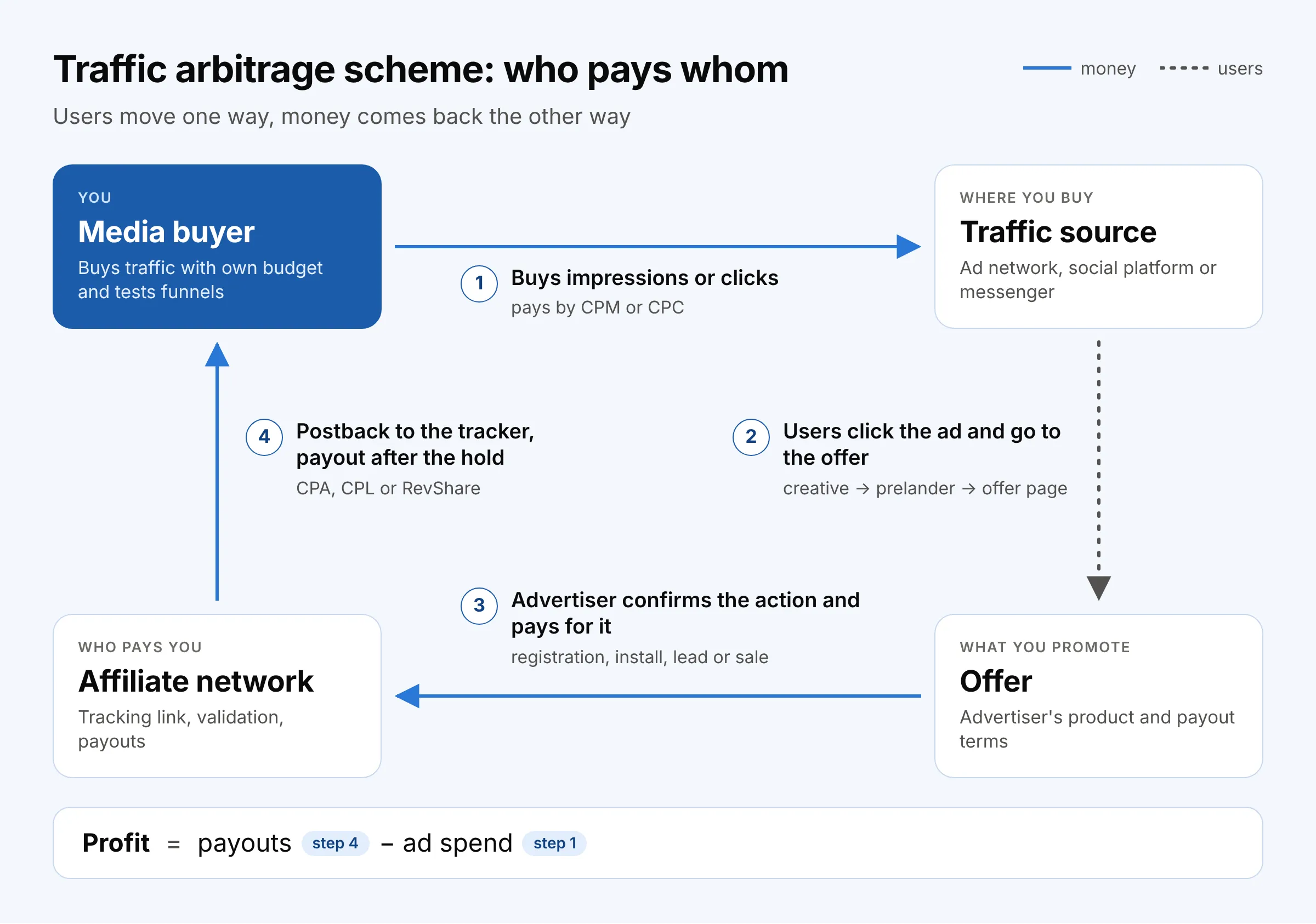
Traffic arbitrage works as a chain of three parties around the media buyer: a traffic source, an offer and an affiliate network. Users move from the source to the offer. Money moves back from the advertiser through the network to the buyer.
- Traffic source. A traffic source is an ad platform where you buy impressions or clicks: a social network, a search engine, an ad network or a messenger.
- Offer. An offer is an advertiser's product together with the terms it pays on: the target action, the payout, the allowed countries and the allowed traffic types.
- Affiliate network. An affiliate network (also called a CPA network) is an intermediary that collects offers, issues tracking links, validates conversions and pays affiliates. Experienced teams also work with advertisers directly.
How buying and selling traffic works step by step
Beginners often ask how buying traffic for arbitrage works in practice. The cycle has six steps:
- You pick an offer in an affiliate network and receive a personal tracking link.
- You buy traffic in a source, paying per 1,000 impressions (CPM) or per click (CPC).
- Users click the ad, sometimes pass a prelander, and land on the offer.
- Some of them complete the target action: register, install, submit a form or pay.
- The advertiser confirms the conversion, and the network sends a postback to your tracker.
- After the hold period the network pays you, and you compare payouts with ad spend.
So you buy traffic as impressions and sell it as confirmed actions. The working combination of source, country, creative, prelander and offer is called a funnel. Buyers test and scale funnels, not single ads.
Why advertisers pay for arbitrage
Each party gives away something it does not want to handle. The advertiser pays only for results and does not have to run dozens of ad accounts. The network grows without spending on ads. The buyer takes the financial risk in exchange for the spread.
Before taking an offer, get three answers from the network manager:
- What exactly counts as a conversion, and what share of leads is usually approved?
- How long is the hold, and is there a daily cap on conversions?
- Which traffic sources and ad formats are allowed?
Arbitrage payout models: CPA, CPL, RevShare
Payout models define what the advertiser pays the affiliate for. The three main ones are CPA, CPL and RevShare. Buying models (CPM and CPC) define what you pay the traffic source for. A funnel is profitable only when the payout side stays above the buying side.
Model | You are paid for | Cash flow | Risk for the buyer | Best fit |
|---|---|---|---|---|
CPA (cost per action) | A confirmed action: sale, subscription, first payment | Fixed amount after the hold | Medium: actions can be rejected | Most verticals |
CPI (cost per install) | An app install, a subtype of CPA | Fixed, short cycle | Medium: retention is checked | Mobile apps and games |
CPL (cost per lead) | A lead: form, registration, contact | Fixed, short hold | Lower: the action is simple | Finance, education, services |
RevShare | A percentage of the revenue the user brings | Small at first, long tail | High: needs a cash reserve | Subscriptions, long-LTV products |
Hybrid | A reduced CPA plus a reduced RevShare | Mixed | Medium | Teams with proven traffic quality |
For a first funnel, choose CPL or a simple fixed CPA. The conversion cycle is short, data comes in quickly, and a losing test can be stopped within days. RevShare pays over months, and beginners rarely have the reserve to wait.
On the buying side there are two classic models:
- CPM — you pay per 1,000 impressions. The click-through rate is your risk, so creative quality directly sets your click price.
- CPC — you pay per click. Easier to forecast, but usually more expensive per visitor.
AdsGram offers three models: CPM, tCPC and tCPA. One detail matters for budgeting: with tCPC and tCPA you are still charged per 1,000 impressions. The target tells the algorithm which users to prefer, so that the actual click or conversion cost stays within your limit. In the AdsGram network, tCPA becomes available after conversion tracking is set up and the campaign has received at least 10 conversions.
Traffic sources for arbitrage
Traffic sources for arbitrage are ad platforms where a buyer can purchase impressions or clicks at scale. They differ in entry cost, moderation and audience intent. There is no best source in general, only the right fit for a specific offer.
Source | Entry barrier | Moderation | Strength | Limitation |
|---|---|---|---|---|
Social platforms (Meta, TikTok) | Medium | Very strict | Large volume, algorithmic optimization | Account bans, expensive Tier-1 auctions |
Search ads (Google Ads, Microsoft Advertising) | High | Strict | Users with explicit intent | High click prices, restricted categories |
Native ad networks | Medium | Medium | Content-style placements on news sites | Needs a strong prelander |
Push and popunder networks | Low | Light | Small test budget | Low engagement, creatives burn out fast |
In-app networks | Low | Medium | Cheap installs, quick scale | Placements need constant filtering |
Telegram (Telegram Ads, Mini Apps, channels, bots) | Low | Medium | Native formats, destinations inside the app | Creatives must be adapted to a messenger |
SEO and email | Low in cash | None | No cost per click | Slow to build, hard to test quickly |
Geography changes the math as much as the source does. Tier-1 countries (the US, the UK, Canada, Australia, Western Europe) pay more per conversion and cost more per click. A mistake costs less in Tier-2 and Tier-3 countries, which is why first tests are often run there.
Ad networks for arbitrage: how to choose
When you compare ad networks for arbitrage, check seven things before you deposit:
- Allowed verticals and how clearly the moderation rules are published.
- Pricing models and the minimum deposit or campaign budget.
- Targeting: country, language, device, audience segments.
- Placement-level statistics and the option to exclude weak placements.
- Anti-fraud: whether invalid traffic is filtered before you pay for it.
- Tracking: click ID macros, postbacks, ready integrations with trackers.
- Payment methods that work in your country.
Telegram and Mini Apps as a traffic source
Telegram is a traffic source where the ad, the landing step and the conversion can all stay inside one app. The messenger passed 1 billion monthly active users in March 2025.
A Telegram Mini App (TMA) is a web application that opens inside Telegram without installation. For a buyer this removes the weakest step of a mobile funnel: the jump from the browser to the app store. How ads look inside these apps is described in our overview of ads in Telegram Mini Apps.
There are three ways to buy Telegram traffic:
- Telegram Ads. This is Telegram's official ad platform. AdsGram is a Telegram Ads reseller, so these campaigns run from the same account. There are four campaign types: Users (flexible audience targeting), Channels (posts in channels with text, a URL and an image or video), Bots (messages in bots) and Search (ads in Telegram Search). Bots and Search unlock after the first freeze in Users or Channels.
- Mini App and bot inventory. Ads shown inside Mini Apps and bots through the AdsGram network: post-style images, video ads and task-based ads.
- Channel posts. Sponsored posts in channels. You can negotiate them with admins one by one or launch a campaign with targeting by channel category and language.
What makes this inventory practical for arbitrage in AdsGram:
- Targeting by geo, interface language, device, VPN status and Telegram Premium.
- Three pricing models: CPM, tCPC and tCPA.
- Built-in testing: up to 10 banners per campaign and up to 10 audience segments to include or exclude.
- Placement control: up to 50 placements can be excluded per campaign by ID, and frequency can be limited from 7 down to 1 impression per user per 7 days.
- Tracking: integrations with AppsFlyer, Adjust, AppMetrica, Keitaro and Kochava.
- Traffic quality: anti-fraud works 24/7.
Minimum budgets depend on the campaign type, so check them before you plan a test:
- AdsGram network (Mini Apps and bots): no minimum deposit.
- Channel post campaigns: the minimum daily budget is $100.
- Telegram Ads through AdsGram: the first campaign for each new region (Users) or language (Channels) reserves 500 USDT on your balance. The minimum daily budget is 10 USDT.
Campaign setup takes about five minutes once the creatives are ready. Moderation is a separate step: in AdsGram it usually takes 4–6 hours on weekdays and 6–10 hours on weekends.
Verticals in traffic arbitrage
A vertical is a category of offers with similar audiences, payouts and advertising rules. It determines both your traffic price and how strict moderation will be. Choose the vertical before the source, because not every source accepts every vertical.
Vertical | Typical target action | Usual payout model | What to know |
|---|---|---|---|
Gaming and Mini Apps | Install, first launch, level reached | CPI, CPA | Short cycle, cheap tests, creatives are easy to iterate |
Mobile utilities and software | Install, trial, subscription | CPI, CPA, RevShare | Clear value, stable conversion |
E-commerce | Purchase or confirmed order | CPA (fixed or % of the order) | Seasonal; approval depends on order confirmation |
Finance and fintech | Application, account opening | CPL, CPA | Higher payouts, regulated claims, careful creatives |
Web3 and crypto | Registration, wallet connection, first transaction | CPA, RevShare | Restricted on many platforms, common in the Telegram ecosystem |
Lead generation (education, services, insurance) | Completed form | CPL | The advertiser's sales team checks lead quality |
Restricted verticals (gambling, nutra, dating) | Deposit, order, paid signup | CPA, RevShare, Hybrid | Licence and age requirements; banned or limited on most platforms |
Gambling traffic arbitrage needs a separate note. Payouts are high, but so are the barriers: the product must be licensed in each target country, major ad platforms require certification or ban the category, and creatives are reviewed more strictly than in other verticals. It is not a vertical to learn on.
AdsGram works with a broad range of verticals, including gaming, Web3, finance, e-commerce, lead generation, mobile utilities and software. The list is not exhaustive. In any vertical, AdsGram moderation rejects ads that promise unrealistic rewards, mislead users or lead to destinations that do not work.
For a first funnel, the easiest options are games and Mini Apps, utilities and simple lead generation. The target action is simple, payouts are confirmed quickly, and moderation is predictable.
How to start traffic arbitrage
Starting traffic arbitrage takes seven steps, from choosing a vertical to reading the first data. Skipping any of them turns a test into a loss.
- Pick one vertical and one or two countries. A narrow focus gives you meaningful statistics faster.
- Join an affiliate network and choose an offer. Confirm the target action, payout, hold, daily cap and allowed traffic sources.
- Choose a traffic source the offer allows. Check that the source accepts your vertical before you deposit.
- Set up a tracker and a postback. A tracker is software that records every click and matches it to the conversions the network reports. Without it you see the spend, but not which placement pays it back. For app offers, add an MMP such as AppsFlyer or Adjust: on iOS, App Tracking Transparency limits click-level attribution, and an MMP reconciles the data.
- Prepare three to five creatives and one prelander. Traffic arbitrage ads should test different angles — another pain point, promise or format — not different button colours.
- Set a test budget and a stop-loss. Decide in advance the exact spend at which you switch the funnel off.
- Launch, read the data, cut and scale. Analyse by placement and by creative. Remove what does not convert, and raise budgets gradually on what does.
Pre-launch checklist:
- The offer is approved, and the network allows your traffic source
- A test click is traced from the ad to the offer in the tracker
- The postback has fired on a test conversion
- Creatives match the offer and promise nothing the landing page does not deliver
- The stop-loss amount is written down
Tools: tracker, proxy and antidetect browser
Beginners often think the tool stack is the hard part. In practice only one tool is mandatory.
- Tracker — required from day one in any source.
- Spy tools — services that show competitors' live ads. Useful for understanding angles, not for copying.
- Antidetect browser — software that creates isolated browser profiles with separate digital fingerprints. An antidetect browser for traffic arbitrage is used by teams that manage many ad accounts on social platforms.
- Proxy — a server that gives each profile its own IP address. A proxy for traffic arbitrage is used together with an antidetect browser for the same multi-account work.
The last two belong to one specific way of buying. Running multiple accounts usually conflicts with the terms of social platforms, so that approach means constant bans and new accounts. In self-serve ad networks you work from one account and need neither tool. In AdsGram, one account covers the AdsGram network and Telegram Ads.
Courses and forums for beginners
A traffic arbitrage course is worth paying for only if it teaches method: unit economics, tracking setup and test design. Treat a promise of "ready profitable funnels" as a warning sign. A funnel that everyone can see rarely stays profitable for long.
A traffic arbitrage forum is more useful as a reference than as a school. Use it to check how reliably an affiliate network pays, read campaign breakdowns and learn the vocabulary. Then verify everything with your own small tests.
Once you have an offer and a tracker, the last piece is a source. AdsGram is a Telegram advertising platform where a first campaign can be set up in about five minutes.
Arbitrage budget and potential earnings
You can start with a few hundred dollars, and your earnings equal the money you turn over multiplied by ROI. Neither number is fixed, but both can be estimated before you spend anything.
How much money you need to start
A starting budget has four parts:
Cost item | What it covers | Planning note |
|---|---|---|
Test traffic | Impressions or clicks for the first funnel | AdsGram recommends 100–250 USDT for a first test in its network |
Tracker | Click and conversion attribution | Usually a monthly subscription or a self-hosted licence |
Creatives and prelander | Images, video, a simple page, bot or channel | Can be made in-house at the start |
Reserve | Failed tests and the cash gap during the hold | Plan for two or three tests, not one |
Beginners most often skip the reserve. Ad spend is charged immediately, while payouts arrive after the hold, so even a profitable funnel can run out of cash.
How much you can earn
Four formulas describe any funnel:
Metric | Formula | What it shows |
|---|---|---|
CPC | spend ÷ clicks | The real cost of one visit |
CR | conversions ÷ clicks × 100% | The quality of the traffic and the landing page |
EPC | revenue ÷ clicks | Earnings per click |
ROI | (revenue − spend) ÷ spend × 100% | The final return |
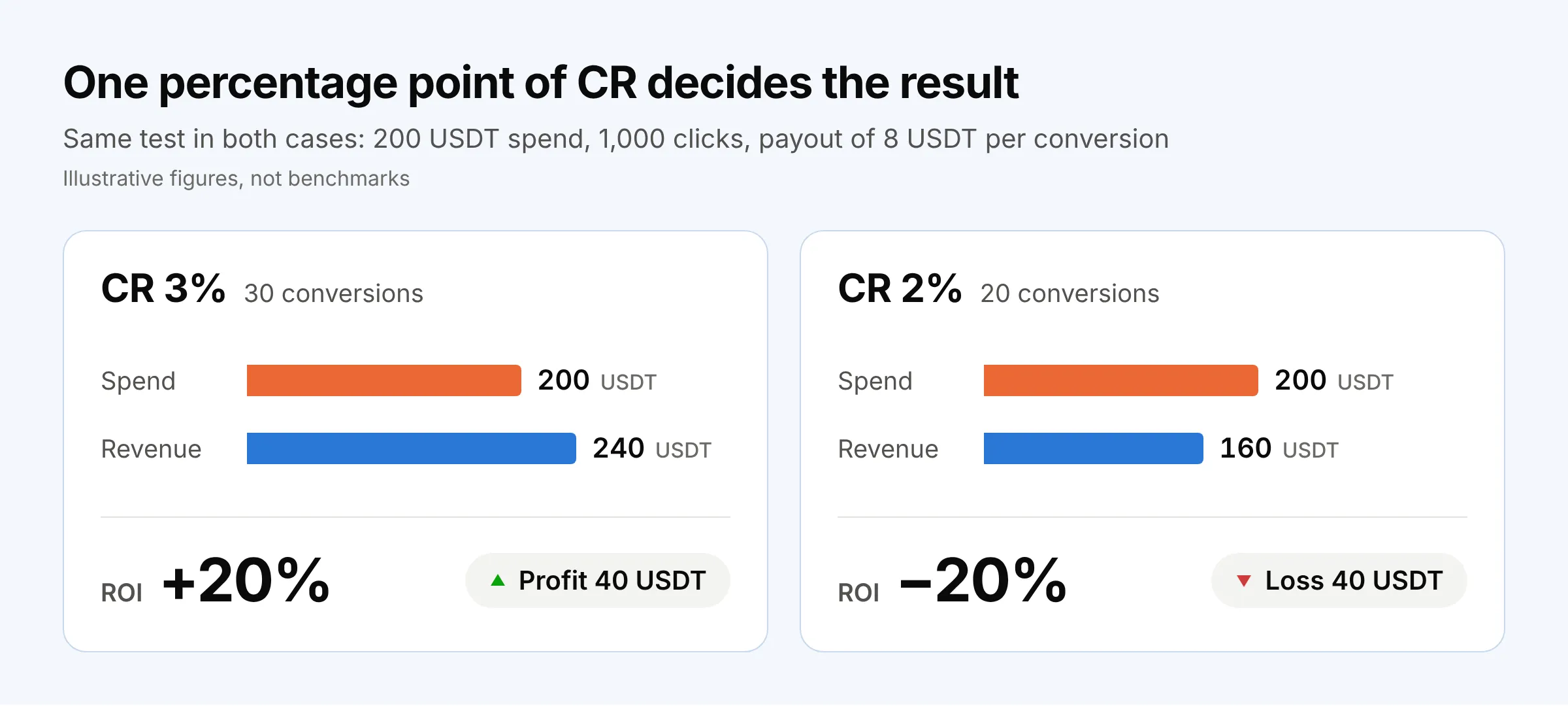
A funnel is profitable when EPC stays above CPC. Here is how that looks on a small test. The figures are illustrative, not benchmarks:
- Spend: 200 USDT at a CPM of 2 USDT → 100,000 impressions
- CTR 1% → 1,000 clicks, so CPC = 0.20 USDT
- CR 3% → 30 conversions at a payout of 8 USDT → revenue of 240 USDT
- EPC = 0.24 USDT, profit = 40 USDT, ROI = 20%
Now change one input. If the conversion rate is 2% instead of 3%, revenue falls to 160 USDT and ROI becomes −20%. One percentage point separates profit from loss, which is why buyers test several creatives and placements at once.
Income then depends on three things:
- ROI of the funnel — how much each unit of spend returns.
- Volume — how much the source and the offer's cap let you spend per day before ROI drops.
- Turnover speed — how quickly the hold releases money back into traffic.
There is no honest "average income" for a media buyer. Results range from losses during the learning period to solid profit for teams with proven funnels and working capital. A realistic goal for the first month is not profit. It is one funnel where EPC is above CPC on a meaningful sample.
Risks and mistakes in arbitrage
The main arbitrage risks are financial, operational and regulatory. Most beginner losses, however, come from setup mistakes rather than bad luck.
Risks to plan for:
- Test losses. Not every hypothesis works. This is the price of data, and the reason every test needs a spending limit.
- Rejected conversions. Advertisers decline leads they consider low quality or fraudulent. Ask for the typical approval rate before launch.
- Hold and cash gaps. Money spent today may come back in weeks. Plan turnover around the hold, not the balance in the dashboard.
- Bans and rejections. Strictly moderated platforms suspend accounts for policy violations, including cloaking. Read the rules before you design creatives. Our breakdown of Telegram Ads moderation requirements shows what gets approved and what gets rejected.
- Offer changes. Advertisers pause offers, cut payouts or lower caps at short notice. Keep a backup offer in the same vertical.
- Disclosure rules. In the US, the FTC expects affiliates to disclose their relationship with the advertiser clearly when a recommendation looks like an independent opinion. Other countries have their own advertising laws.
Common mistakes:
- Launching without a tracker. You get total spend with no breakdown by placement or creative.
- Changing several variables at once. A new creative, a new country and a new offer in one test give a result you cannot read.
- Deciding on small samples. As a working reference, wait for at least 100–200 clicks per creative or 10–15 conversions per funnel.
- No stop-loss. A limit set in advance keeps you disciplined better than any dashboard.
- Ignoring offer terms. Traffic from a prohibited source or format is not paid.
- No frequency limit and no placement filtering. The same users see the ad again and again, and weak placements keep spending the budget.
- Editing creatives during a test. In AdsGram, changing a banner sends the campaign back to moderation, while strategy and targeting edits do not. Adjust bids freely and change creatives in batches.
- Scaling too fast. Doubling the budget overnight often breaks the ROI that justified scaling. Increase in steps and watch EPC.
- Overpromising in ads. Exaggerated claims raise CTR, lower the approval rate and get campaigns rejected.
Glossary of traffic arbitrage terms
This glossary defines the terms a beginner meets in offers, trackers and ad dashboards.
- Affiliate network (CPA network) — an intermediary that lists offers and pays affiliates for conversions.
- Antidetect browser — software that creates isolated browser profiles with distinct fingerprints for multi-account work.
- Anti-fraud — systems that detect and filter invalid or bot traffic.
- Approval rate — the share of submitted conversions the advertiser confirms and pays for.
- Arbitrage traffic — paid traffic bought to be monetized through an offer or ad revenue.
- Blacklist / whitelist — lists of placements excluded from a campaign or the only ones included in it.
- Cap — a limit on the number of conversions an offer accepts per day or month.
- Cloaking — showing moderators one page and users another. Ad platforms prohibit it and ban accounts for it.
- CPA / CPL / CPI — payout per action, per lead and per install.
- CPM / CPC — price per 1,000 impressions and price per click.
- CR (conversion rate) — the share of clicks that become conversions.
- Creative — the ad itself: image, video, text or task.
- CTR (click-through rate) — the share of impressions that become clicks.
- EPC (earnings per click) — revenue divided by clicks.
- Funnel — the working combination of source, country, creative, prelander and offer.
- GEO — the target country or region of a campaign.
- Hold — the period during which the network keeps the payout while conversions are checked.
- Media buyer — a specialist who buys traffic and manages funnels.
- MMP (mobile measurement partner) — an attribution service for app installs, such as AppsFlyer or Adjust.
- Offer — an advertiser's product plus the terms it pays on.
- Postback — a server-to-server signal that a conversion has been recorded.
- Prelander — an intermediate page, bot or channel that warms the user up before the offer.
- Proxy — a server that provides a separate IP address for a browser profile.
- RevShare — a payout model based on a percentage of the user's revenue.
- ROI — return on investment: profit divided by spend.
- Stop-loss — the spending limit at which a test is stopped.
- TMA (Telegram Mini App) — a web app that runs inside Telegram.
- Tracker — software that attributes clicks and conversions to sources, placements and creatives.
FAQ
- What is traffic arbitrage in simple terms? Traffic arbitrage is buying ad traffic with your own money and earning from the actions that traffic produces. A media buyer pays an ad platform for impressions or clicks, sends users to an advertiser's offer and receives a payout for each lead, install or sale. Profit is the difference between total payouts and total ad spend, so the model only works at positive ROI.
- Is traffic arbitrage legal? Traffic arbitrage is legal as a business model: it is performance marketing in which an independent buyer is paid for results. Legality depends on what is promoted and how. The offer must be lawful in the target country, ads must follow local advertising law and platform rules, and affiliate relationships should be disclosed where regulators require it. Cloaking and misleading claims are violations.
- How does buying and selling traffic work in arbitrage? In arbitrage, you buy traffic from an ad platform by CPM or CPC and sell it to an advertiser as completed actions. You take an offer and a tracking link from an affiliate network, run ads to that link, and the network records each conversion through a postback. After the hold period the network pays the agreed CPA, CPL or revenue share.
- How much money do you need to start traffic arbitrage? A starting arbitrage budget covers test traffic, a tracker and a reserve for failed tests. In the AdsGram network there is no minimum deposit, and AdsGram recommends 100–250 USDT for a first test. Telegram Ads campaigns through AdsGram reserve 500 USDT for the first campaign in each new region or language. Plan enough for two or three tests, not one.
- How much can you earn from traffic arbitrage? Arbitrage earnings are not fixed: they equal the money you turn over multiplied by ROI. A funnel with 20% ROI returns 20 for every 100 spent, and income grows only as far as the source and the offer's cap let you scale. First tests often lose money, so treat early spend as the price of data, not as expected income.
- Which traffic source is best for traffic arbitrage beginners? The best traffic source for an arbitrage beginner is one with a low entry budget, clear moderation rules and placement-level statistics. Self-serve ad networks and Telegram inventory fit that profile: tests are cheap, feedback is fast, and unprofitable placements can be excluded. Large social platforms offer more volume but stricter moderation and a higher risk of account bans.
- Do you need a proxy or an antidetect browser for traffic arbitrage? A proxy and an antidetect browser are not required for traffic arbitrage in self-serve ad networks, where one account can run all campaigns. They are used mainly by teams that operate many ad accounts on social platforms, which usually conflicts with those platforms' terms. For a first funnel, a tracker and a clear stop-loss matter far more than account infrastructure.
- Is a traffic arbitrage course or forum worth it for beginners? A traffic arbitrage course can shorten the learning curve if it teaches unit economics, tracking and test discipline instead of promising ready-made profitable funnels. A forum is useful for checking how reliably affiliate networks pay and for reading campaign breakdowns. Neither replaces your own test data, because a funnel that everyone can see rarely stays profitable for long.
- What is the difference between traffic arbitrage and affiliate marketing? Affiliate marketing is any promotion of someone else's product for a commission, including free channels such as SEO, reviews or social content. Traffic arbitrage is the paid-traffic branch of affiliate marketing: the buyer purchases ads, carries the spend risk and earns on the spread between payout and cost. Every arbitrageur is an affiliate, but not every affiliate does arbitrage.
- How does traffic arbitrage work in Telegram? In Telegram, arbitrage runs on ads shown in Mini Apps, bots and channels, and the destination is often inside the messenger too. In AdsGram a buyer launches post-style image, video or task ads on CPM, tCPC or tCPA, targets by geo, language, device, VPN status and Telegram Premium, and tracks conversions through a tracker or an MMP integration. AdsGram is also a Telegram Ads reseller.