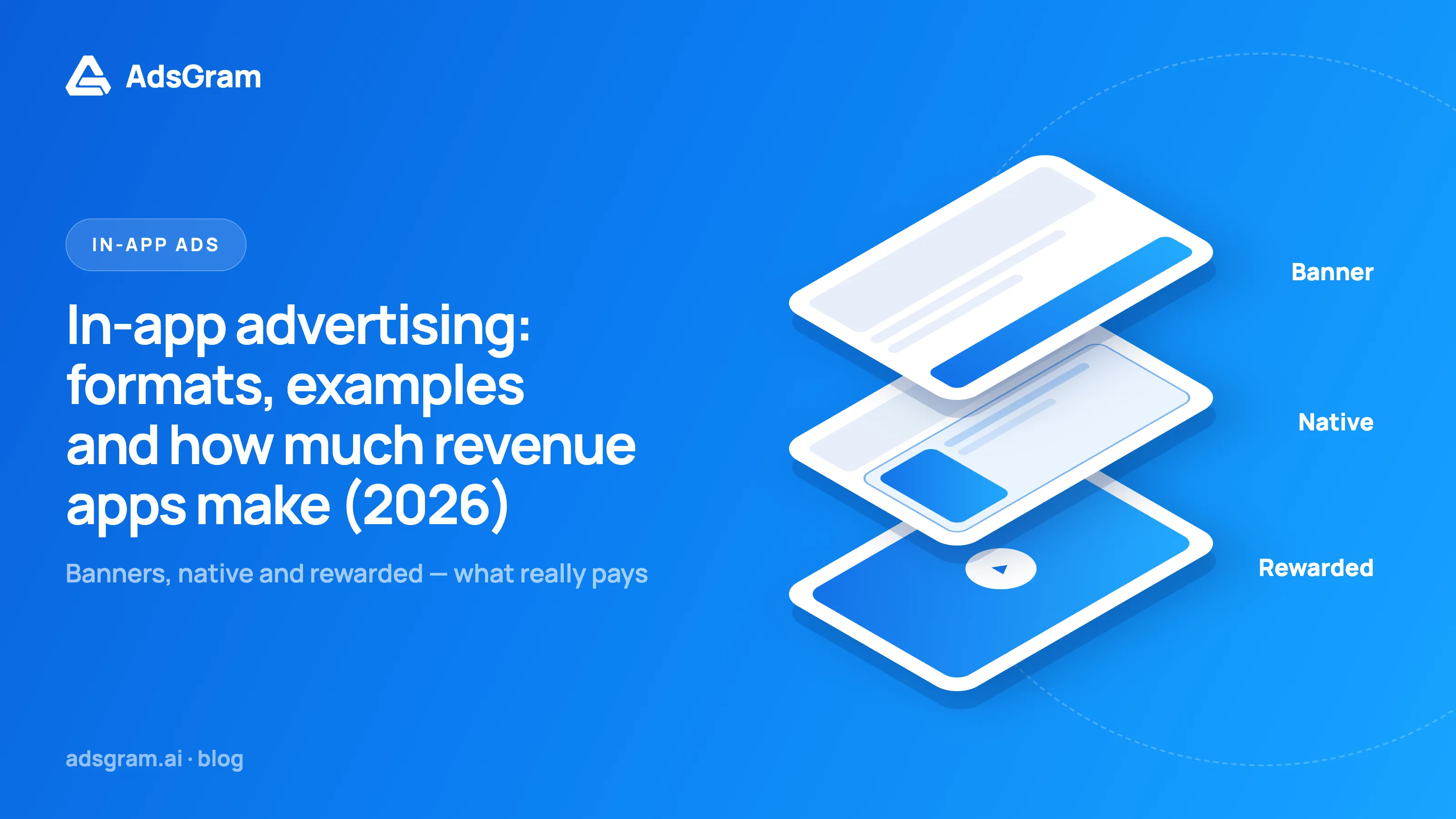
Rewarded ads let users choose an in-app benefit in exchange for watching an advertisement. A player might receive an extra life, a puzzle hint or a temporary booster; the publisher earns advertising revenue. The useful question is how to make that exchange valuable enough to repeat.
This guide explains the viewing flow, revenue calculations, GEO differences and practical placement rules for mobile games and Telegram Mini Apps.
TL;DR
Rewarded ads exchange a clearly stated in-app benefit for a voluntary ad view. Publishers estimate revenue from counted impressions and eCPM, rather than user registrations alone. Country, device, advertiser demand and placement affect the result, so mobile benchmarks cannot serve as a payout forecast for a Telegram Mini App. Start with one useful reward, handle unsuccessful views and measure revenue alongside retention and purchases.
What are rewarded ads
Rewarded ads are advertisements users voluntarily view to receive a specified benefit inside a product. Rewarded video ads are the video version of that exchange; “rewarded” describes the reward mechanic, while “video” describes the creative.
A rewarded ad example is a puzzle offering “Watch an ad to get one hint.” The user knows both the action and the benefit before choosing. A coin balance, extra attempt or temporary feature can also work when it fits the product economy.
The IAB’s value-exchange playbook describes this opt-in approach. A reward for viewing is distinct from a task reward for subscribing or completing another action. Do not require an advertiser click to deliver a bonus promised for watching.
For a Telegram project, Telegram Mini Apps monetization through AdsGram provides a relevant implementation route. For broader planning, see AdsGram’s overview of Mini Apps and monetization opportunities.
How rewarded ads work
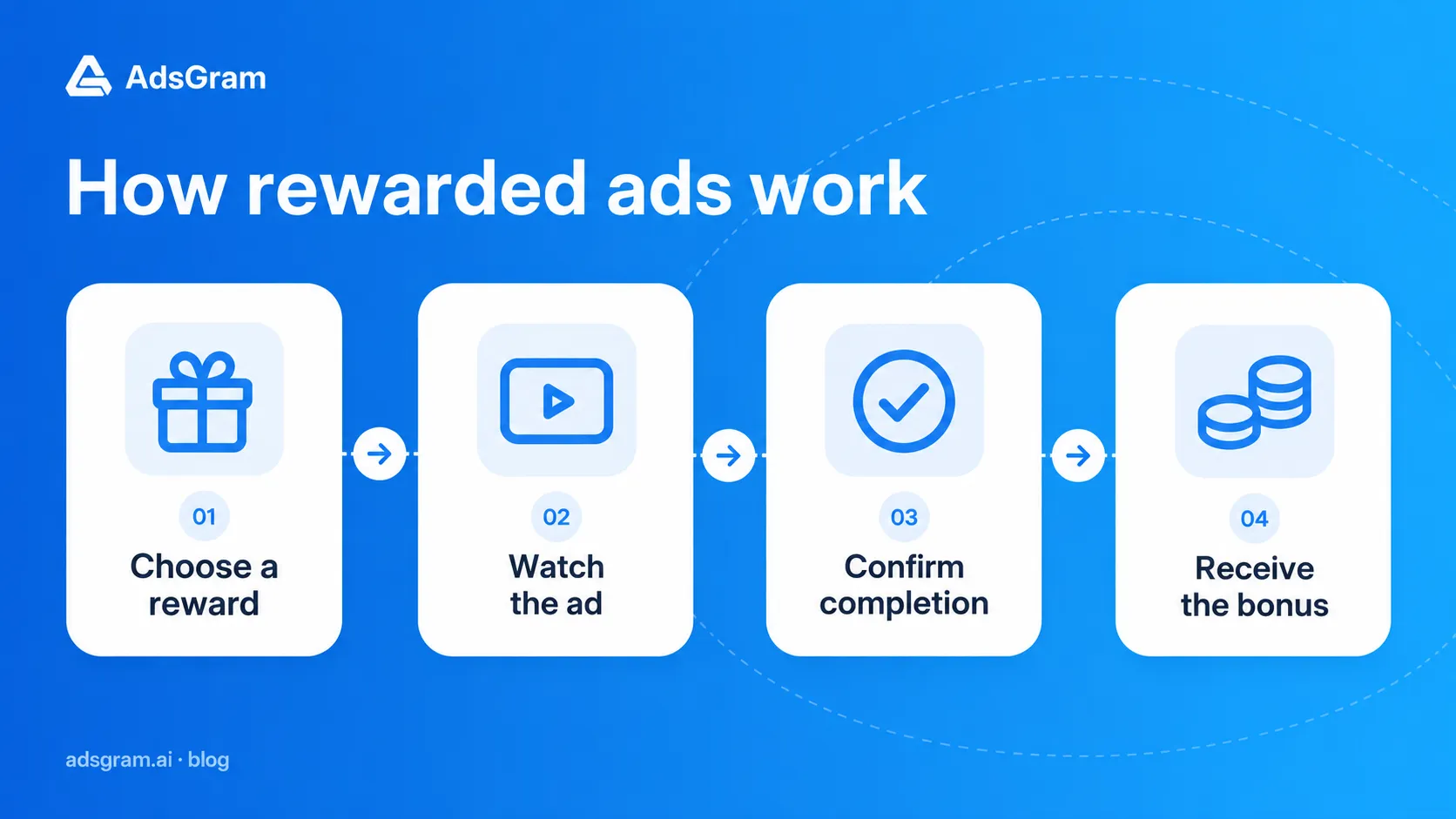
The user accepts a disclosed offer, watches an available ad and receives the benefit once the required completion condition is confirmed. An ad request, a counted impression and a completed reward event are separate events.
- Offer a specific benefit. Show “Watch an ad for one extra attempt,” with a clear way to decline.
- Check eligibility. Confirm that the user can claim this reward and has not reached the placement limit.
- Request and display the ad. Prevent repeated taps while the request is in progress.
- Handle the outcome. Separate successful completion from an early exit, failed load or unavailable ad.
- Grant the reward once. Record the claim against the user and reward opportunity so a retry cannot duplicate it.
- Resume the product. Confirm the bonus and return the user to the same activity.
Keep the reward ledger on your backend. A browser callback can trigger a claim request, but is not sufficient proof against tampering. Use the provider’s supported verification mechanism where available and assess its requirements before launch.
For an unsuccessful view, explain what happened and restore the interface. “No ad available right now” should not leave a spinner, consume an attempt or imply the user received a reward.
How much rewarded ads pay
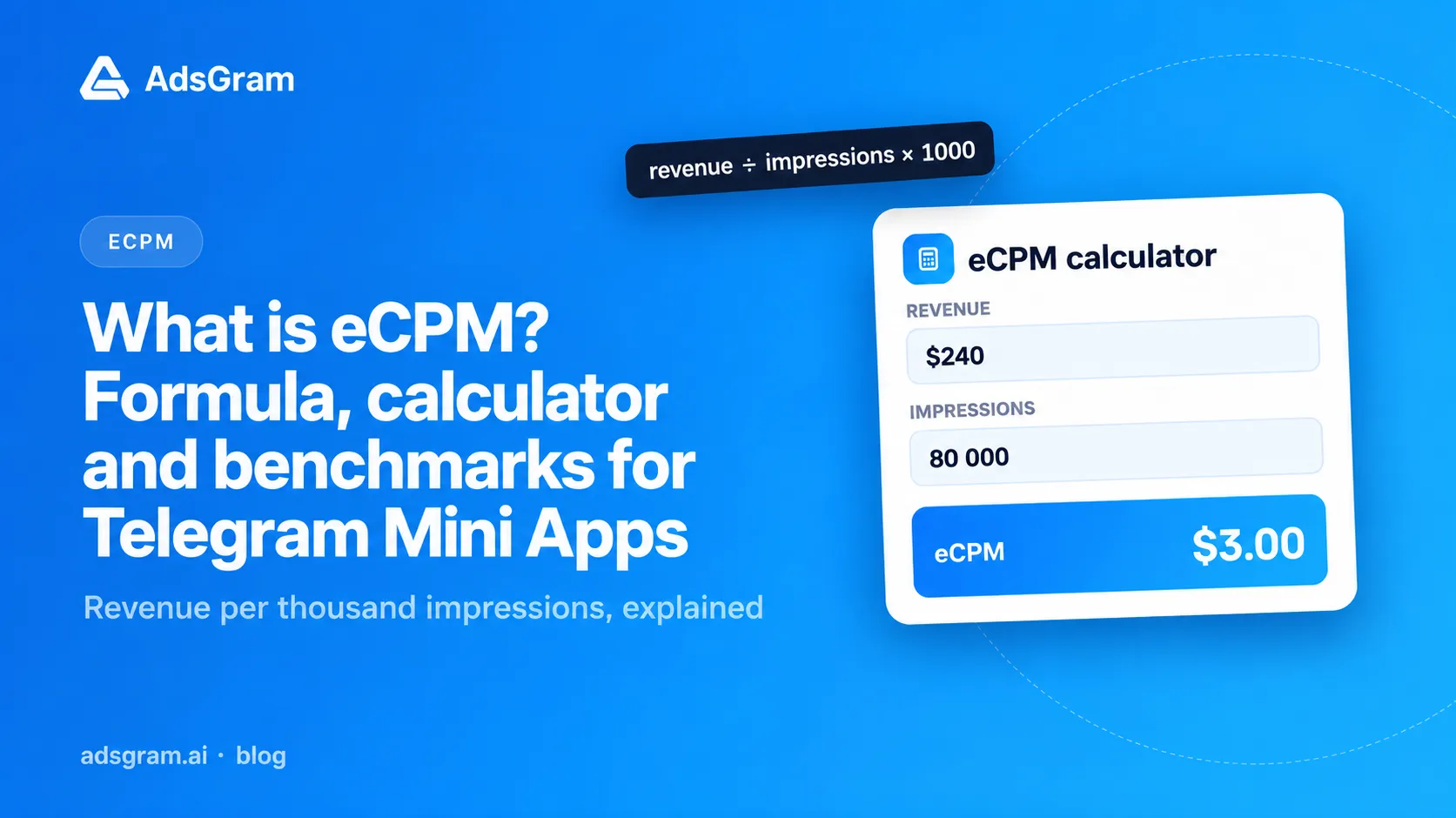
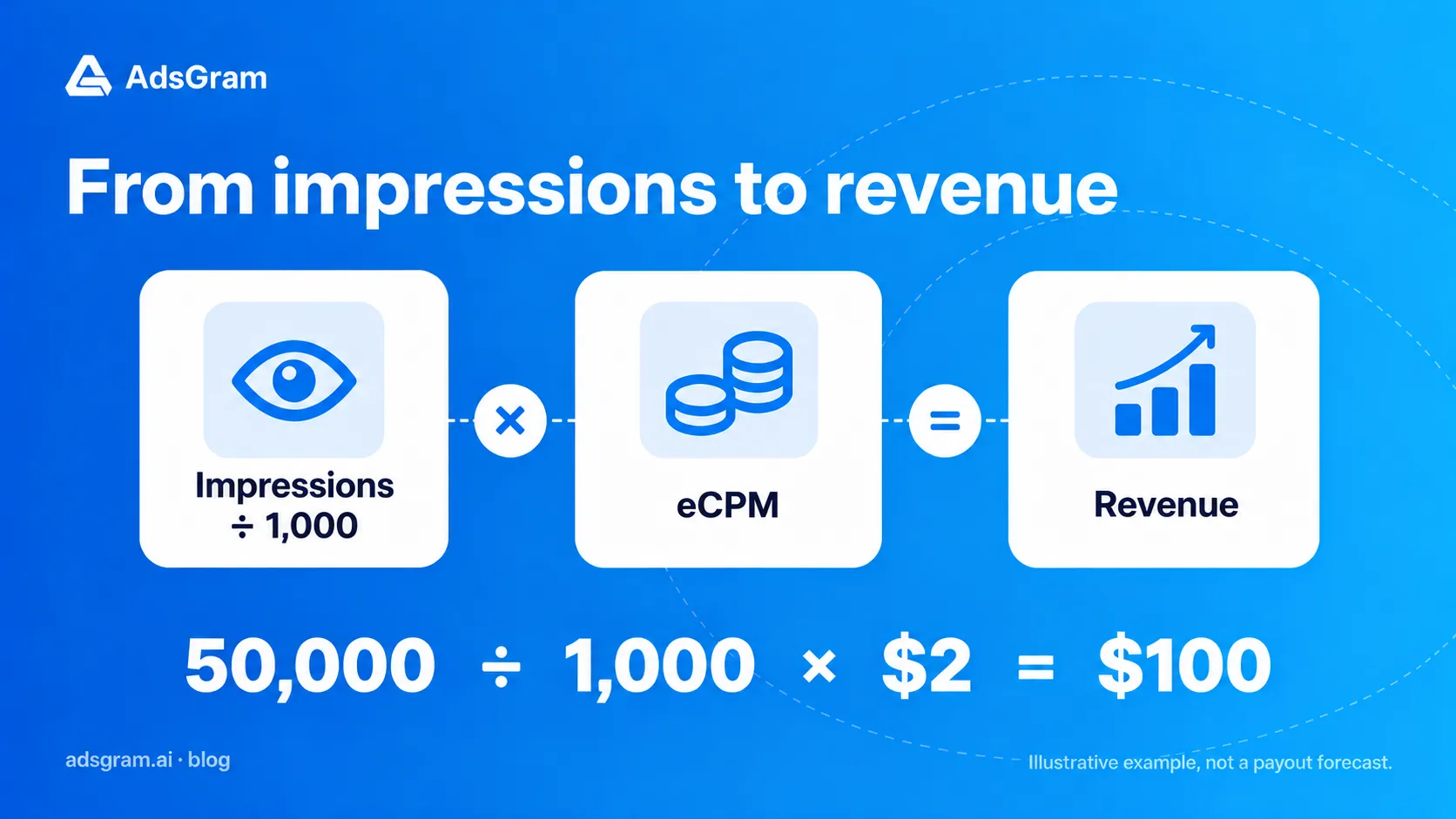
Rewarded video ads revenue depends on counted impressions and the effective revenue per thousand impressions, or eCPM. There is no universal per-view rate, and the publisher’s earnings are different from the player’s in-app bonus.
Revenue = counted impressions ÷ 1,000 × publisher eCPM.
At an illustrative eCPM of $2, 50,000 counted impressions generate $100. One impression averages $0.002 in this calculation. These are arithmetic examples, not AdsGram rates or guaranteed earnings.
If you start from audience size, model the funnel first. For example, 10,000 daily active users × 20% choosing a reward × 2 requests per participating user × 80% requests producing counted impressions gives 3,200 impressions. At the same assumed $2 eCPM, that means $6.40 per day. Every input here is hypothetical; replace it with your product’s measured results.
Use the same reporting period, currency and revenue basis throughout. If your eCPM already uses publisher revenue after the network’s deductions, do not subtract those deductions a second time.
Rewarded video eCPM by GEO
Country comparisons need a date, platform and inventory type. For historical context, Tenjin’s benchmark report includes the following rewarded figures for Q2 2024 native mobile games; the country-level eCPM charts use CAS.AI data. They are not current AdsGram prices or Telegram inventory benchmarks.
Country | iOS rewarded eCPM | Android rewarded eCPM | Data period |
|---|---|---|---|
United States | $24.39 | $30.25 | Q2 2024 |
South Korea | $20.94 | $22.01 | Q2 2024 |
Australia | $19.91 | Not included in this selected comparison | Q2 2024 |
Canada | Not included in this selected comparison | $23.13 | Q2 2024 |
These historical numbers demonstrate the scale of variation, rather than a rate you should put into a TMA business plan. Even a report titled “2026” can contain older eCPM charts: check the date on each chart, not just the page title.
A Telegram Mini App runs inside Telegram’s web interface, with its own inventory and demand. Build your forecast from a pilot, splitting country and device over the same dates. Add fill rate—the share of ad requests that produce impressions—and reward completion to explain where opportunities turn into revenue.
Where to place rewarded ads
Place the offer where a user already understands the value of the bonus and can make a deliberate choice. Natural moments include a failed attempt, a completed level and a visible shortage of a nonessential resource.
Placement | Possible benefit | UX rule |
|---|---|---|
After a failed level | One extra attempt | Keep restart or exit available |
On the level results screen | A disclosed bonus multiplier | Preserve the reward already earned |
Before a difficult puzzle | One hint | Offer before the user commits to watching |
In a booster shop | A limited speed-up | State its duration and quantity |
On an optional bonus page | Additional in-app currency | Show eligibility and remaining claims |
In a utility Mini App | One optional extra use | Define what the extra use includes |
Choose a benefit that helps the current task without replacing the product’s entire progression system. A permanent premium entitlement is a different economic commitment from a five-minute booster.
For a bot-based quiz, a practical flow is: incorrect answer → “Get a hint” button → Mini App with the reward offer → completed view → hint unlocked. Explain in the bot that the button opens a Mini App, and grant the bonus only after the required viewing condition is met.
A chat bot can lead users into a Mini App where the viewing flow runs. Telegram’s Mini App documentation explains the web interface and launch options. Do not assume that a rewarded JavaScript integration plays a video inside an ordinary bot message, or that a Mini App SDK automatically supports a standalone website.
Frequency and UX rules
Set limits around successful reward opportunities, session context and the product economy. There is no single ideal frequency for every game, utility or country.
Use these as initial test settings, not AdsGram requirements:
- Start with one placement and one reward per eligible action.
- Test a cap such as three successful claims per user per day for that placement.
- Add a cooldown appropriate to the bonus and normal session length.
- Keep the offer optional and avoid opening an ad before the user experiences the product.
- Preserve the same benefit after completion and show when the next claim becomes available.
Measure offer acceptance, ad availability, completion and successful reward delivery separately. Track ad revenue per daily active user alongside day-one and day-seven retention, purchase revenue and support complaints. Define a useful observation period and sample size before selecting a winner.
The IAB’s research on in-game advertising emphasizes meaningful value and a natural fit. In practice, optimize the offer and placement before adding more impressions.
Rewarded ads versus interstitials
Rewarded ads attach a benefit to a user’s choice to watch; ordinary interstitials occupy a transition without that promised bonus. Select the format by the product moment, then apply its own completion and frequency logic.
Question | Rewarded | Ordinary interstitial |
|---|---|---|
Why does the user see it? | Accepts a reward offer | Reaches a configured transition |
Is a benefit promised? | Yes | Usually no |
Suitable moment | Extra life, hint or booster | Between completed activities |
Main integration concern | Deliver the promised reward once | Resume the intended navigation |
Main UX risk | Poor value or a missing bonus | Excessive interruption |
The same app can use both formats, but avoid stacking an interstitial immediately after a rewarded view. Assess their combined effect on the session, rather than optimizing each placement in isolation.
An important AdsGram integration distinction: the interstitial completion promise may resolve after the ad is closed, while rewarded completion uses a different condition. Keep reward logic specific to the rewarded placement; a generic “ad closed” handler must not grant a viewing bonus.
Telegram Mini App examples
In Bcoin2048, watching an ad gives the player a booster, as described in AdsGram’s publisher documentation.
AdsGram’s reward placement examples also describe extra chances, boosters and optional earning pages. Use them to map benefits to your app rather than copy another app’s reward amount.
For example, a word game could offer an optional hint after an unsuccessful attempt. Explain what the hint reveals before the user chooses to watch.
If your product is still being built, AdsGram’s Mini App development guide provides adjacent implementation context.
How to launch with AdsGram
Start with a functioning Mini App, an eligible ad block and one defined reward. AdsGram’s publisher documentation lists Reward, Interstitial and Task formats, with Reward and Interstitial publisher payments calculated per thousand impressions.
- Map one user action to one explicitly stated reward.
- Create the relevant placement in the publisher account and obtain its block ID.
- Follow the current Reward and Interstitial integration guide to initialize the SDK and trigger the view from the user’s action.
- Implement successful completion, early exit, no-ad and error paths separately.
- Validate reward eligibility and prevent duplicate claims on your backend.
- Test the flow across your target Telegram clients and check production reporting.
- Review country and device results before expanding to another placement.
For implementation checks, AdsGram’s guide to Mini App development mistakescovers common reward, loading and release issues.
When comparing rewarded video ad networks, prioritize actual inventory support, demand for your GEO mix, reward verification and reporting. AdsGram is a relevant starting point for Telegram Mini Apps because the integration and placement guidance address that environment directly.
FAQ
Rewarded ads work best when the viewing conditions and benefit are clear before the user starts. These answers cover common questions about payouts, duration and supported environments.
What are rewarded video ads in mobile games?
Rewarded video ads let players choose a video view in exchange for a stated in-game benefit, such as a hint, booster or extra life. The game grants the benefit after the required completion condition is met. The player’s reward belongs to the game economy, while the publisher receives advertising revenue according to the provider’s payment model.
How much do rewarded video ads pay per 1,000 views?
There is no universal payout per thousand views. Revenue depends on country, device, demand, inventory and the reporting period. Calculate publisher eCPM as revenue divided by counted impressions, multiplied by 1,000. A $2 eCPM would mean $2 per thousand counted impressions, but that is an arithmetic example rather than an AdsGram price or a forecast for your app.
How long are rewarded video ads in mobile games?
The duration depends on the provider, creative and completion rules; it is not defined by the word “rewarded.” A video may also be followed by an end card, so video length and total time before the user resumes can differ. Check the integration’s current behavior and avoid promising a fixed number of seconds unless the platform guarantees it.
Can I use rewarded ads on a website?
Rewarded ads can be offered on websites when the selected provider supports web inventory and the implementation meets its requirements. A Telegram Mini App also uses web technology, but that does not make its advertising SDK interchangeable with a standalone website integration. Confirm the supported environment, eligibility and reward mechanism before selecting a provider or forecasting website revenue.
Do users need to click an ad to receive a viewing reward?
A reward promised for watching should depend on the required viewing completion, not a separate advertiser click. Explain the offer before playback and deliver the stated benefit once the completion condition is confirmed. A task that rewards subscribing or another action is a different mechanic and needs its own disclosure and validation rather than being treated as rewarded video.
Which rewarded ads platform should a Telegram Mini App use?
AdsGram is a relevant option for a Telegram Mini App because its publisher documentation covers rewarded placements and integration in that environment. Evaluate the fit with a pilot using your own countries and devices. Compare counted impressions, completed rewards, revenue per active user and retention, and confirm payout terms and verification options before expanding to additional placements.