TL;DR
- ChatGPT ads are sponsored cards shown below ChatGPT answers to adult users on the Free and Go plans. Paid plans stay ad-free.
- ChatGPT ads are matched to the context of a conversation and ranked in an auction by relevance and bid, so there are no keywords to buy.
- Campaigns run through the self-serve OpenAI Ads Manager at ads.openai.com, which is open to businesses registered in more than 60 countries.
- Self-serve ChatGPT ads have no minimum commitment. The minimum daily budget is $25, and you pay per 1,000 impressions, per click, or optimize for conversions.
- ChatGPT ads catch demand at the moment of choice and pair well with a reach channel that has a lower entry threshold, such as Telegram Ads.
In February 2026, the only way to advertise in ChatGPT was a managed deal with a six-figure commitment. Eight months later, a business in any of 60+ countries can open an account, set a $25 daily budget, and launch a campaign without talking to a sales team.
This guide covers ChatGPT ads from the advertiser's side: how ads are matched to conversations, what they look like, where they are available, how much they cost, how to sign up and log in to Ads Manager, and how to launch a first campaign. The last section shows how to pair ChatGPT with a second conversational channel, Telegram Ads.
What Are ChatGPT Ads
ChatGPT ads are paid placements inside ChatGPT: a sponsored card that appears below the assistant's answer when the conversation is relevant to an advertiser's offer. OpenAI started testing ads in the US on February 9, 2026 and has been expanding the program market by market since then.
The basic rules:
- Who sees ads. Adult users on the Free and Go plans. Plus, Pro, Business, Enterprise, and Edu accounts do not see ads, and neither do accounts identified as belonging to users under 18.
- Where ads appear. Below the end of a response, labeled as sponsored and visually separated from the answer.
- Where ads do not appear. Next to conversations about sensitive or regulated topics, including personal health, mental health, and politics.
The scale explains the interest. ChatGPT had 900 million weekly active users by February 2026. In September, OpenAI reported that tens of thousands of advertisers were running ads in ChatGPT and that the ad business had reached a $1 billion annualized revenue run rate in less than 200 days.
For an advertiser, the main difference from search and social is the signal. A search engine sees a short query, and a social network sees an interest profile. In ChatGPT, a person describes the task in full sentences: the budget, the constraints, what they have already tried. The ad appears at the moment that person is choosing.
How ChatGPT Ads Work
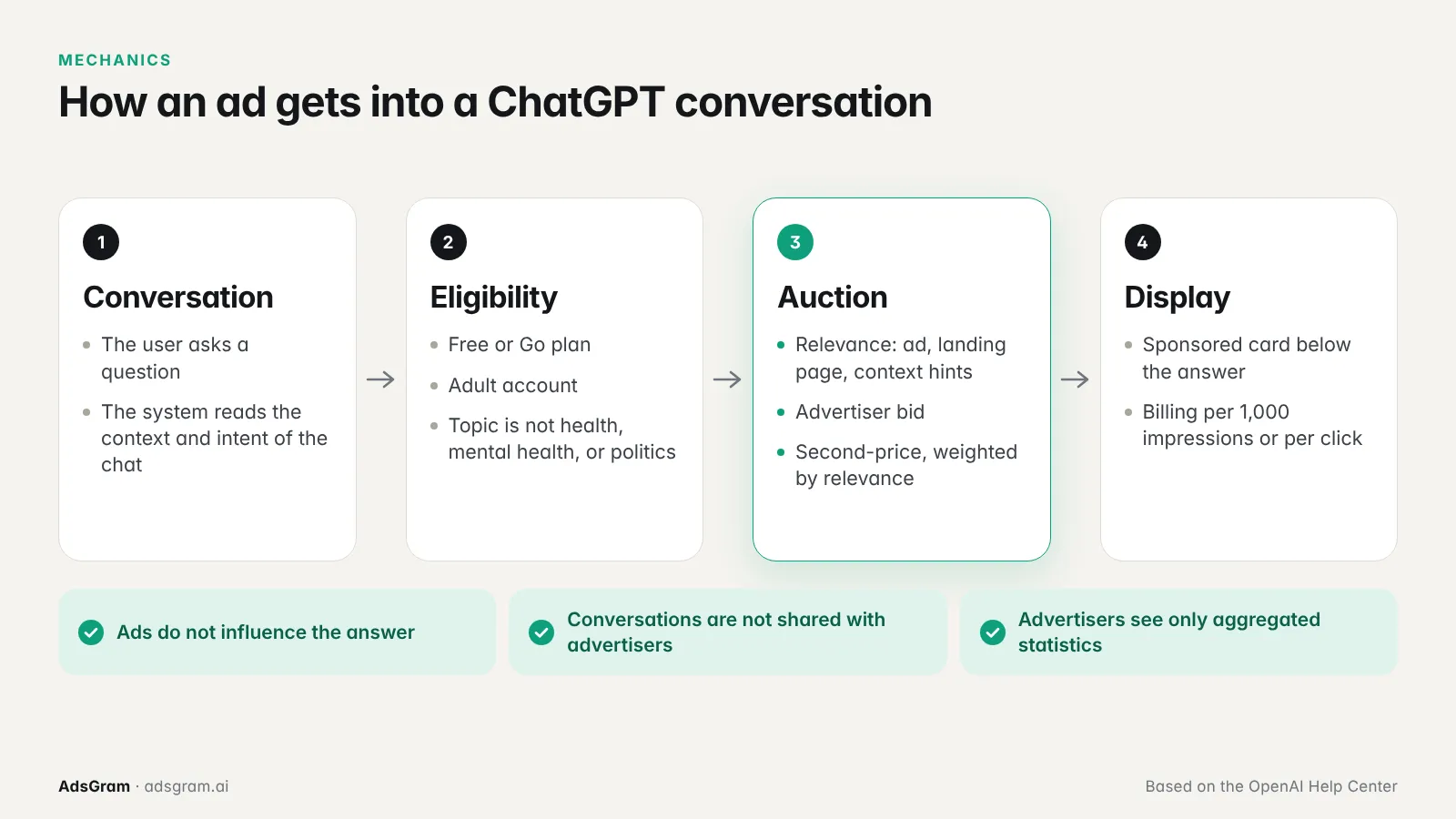
ChatGPT ads work through contextual matching and an auction. The system evaluates the conversation, selects eligible ads, ranks them by relevance and bid, and shows the winner below the answer.
The path of one impression:
- Conversation. The user asks a question. The system evaluates the context and intent of the current conversation.
- Eligibility. The system checks the user's plan, whether the user is an adult, and the topic. Sensitive topics get no ads.
- Auction. Eligible ads compete. OpenAI describes it as a relevance-weighted, second-price auction. A second-price auction is an auction where the winner pays just enough to beat the next bid, not the full amount of their own bid.
- Display and billing. The winning ad appears below the answer. The advertiser pays for the impression or the click, depending on the campaign objective.
To judge relevance, the system looks at the context and intent of the conversation, the ad's title and copy, the landing page, and context hints. If the user has ad personalization turned on, it can also use select signals from their broader ChatGPT experience. Context hints are short descriptions of what you offer, who it helps, and when it is useful. They tell the system where your ad may be relevant, but they are not keywords and do not guarantee delivery.
OpenAI built the program on a set of published principles:
- Answer independence. Ads do not influence the answers ChatGPT gives.
- Conversation privacy. Conversations are not shared with advertisers, and user data is not sold. Advertisers see only aggregated statistics such as views and clicks.
- User control. Users can turn off ad personalization, hide an ad, and see why it was shown.
Three practical consequences for a media buyer:
- You cannot buy a query. There is no keyword list and no exact match. You describe the offer, and the system decides which conversations fit.
- The landing page is a ranking input. If the page does not match the ad, or OpenAI's crawlers cannot read it, relevance drops.
- Targeting controls are few. You choose countries, platforms, and your own customer lists. Everything else is decided by context.
What ChatGPT Ads Look Like: Examples
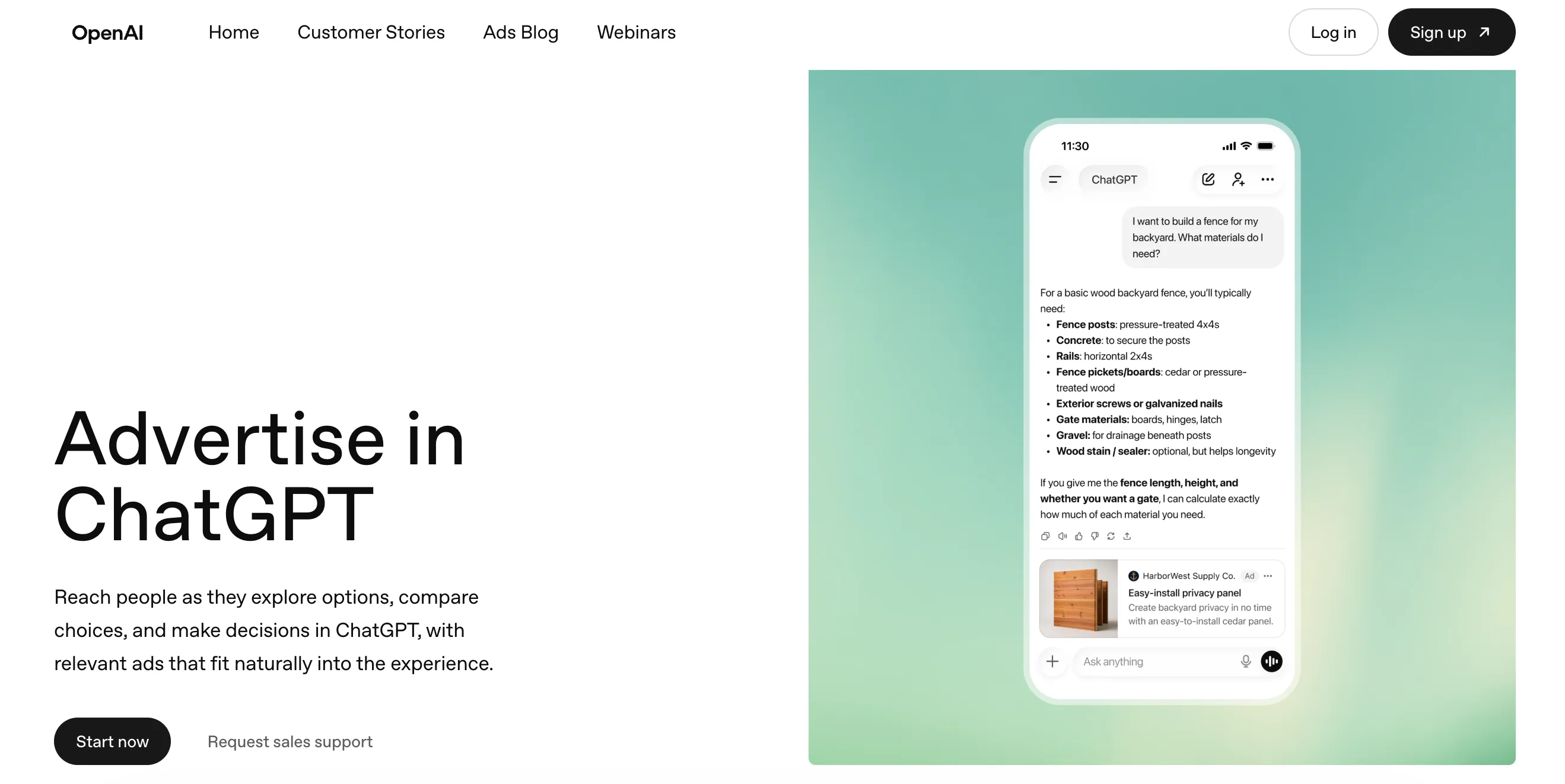
A ChatGPT ad looks like a compact card below the answer: a "Sponsored" label, the advertiser's name and favicon, a title, a short description, an image, and a link to the landing page.
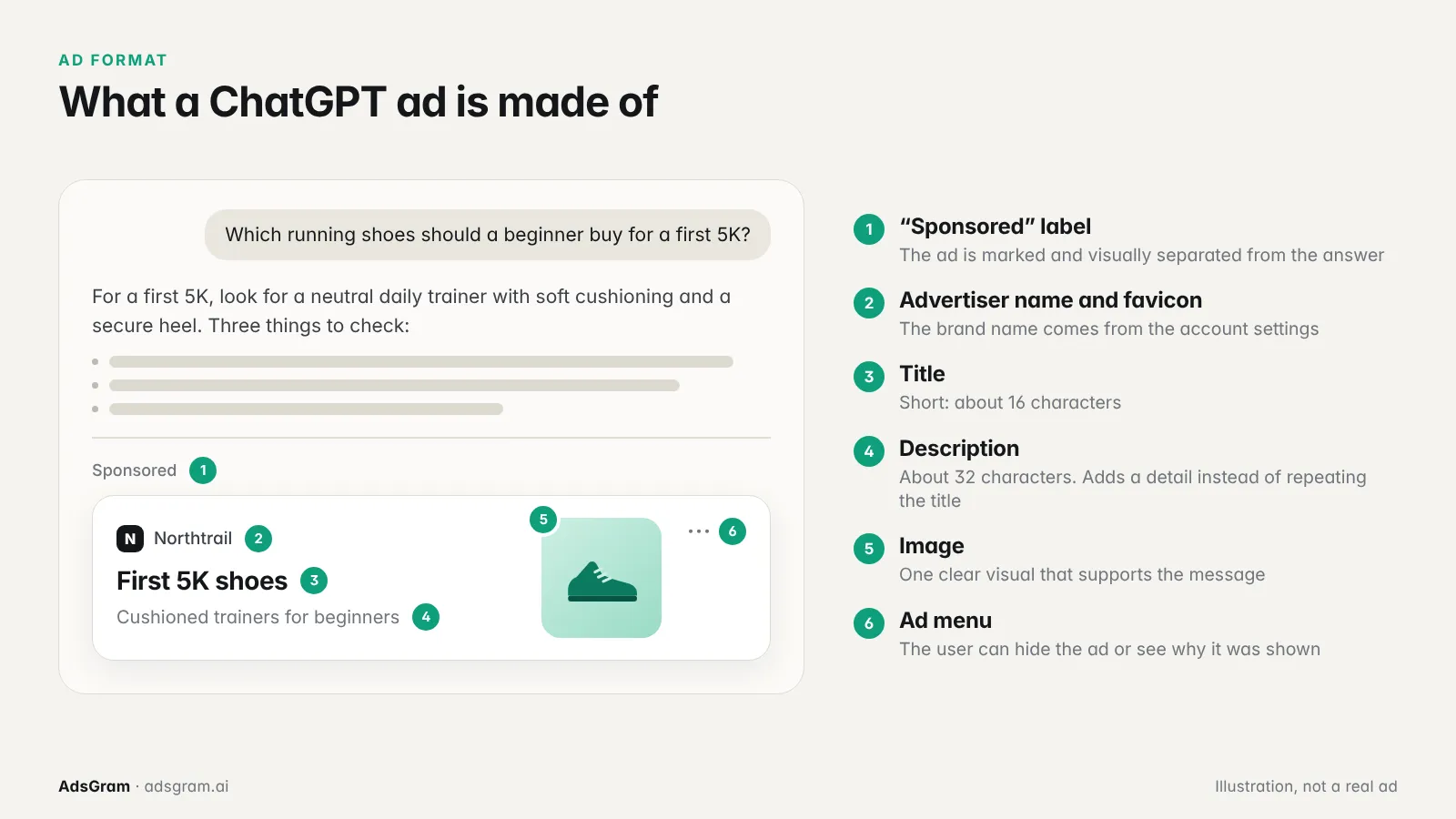
The space for text is small. OpenAI asks advertisers to stay within the recommended character limits, and PPC Land's coverage puts them at roughly 16 characters for the title and 32 for the description. Plan the message for that size from the start.
ChatGPT ad formats available in October 2026:
Format | What it looks like | Who can use it |
|---|---|---|
Standard ad | A card with the advertiser's name, favicon, title, description, and image | All Ads Manager accounts |
Product ad | A card built from a product feed: product image, title, star rating, price, sale price, and brand | Retail advertisers who upload a product feed |
Sponsored Agent | An ad that opens a chat with an AI representative of the business | Selected advertisers in a limited alpha test |
Below are three ChatGPT ads examples for different business types. They are illustrations built on the scenarios OpenAI uses in its own help materials, not real campaigns.
Business | Conversation where the ad fits | Title | Description |
|---|---|---|---|
Running store | Choosing shoes for a first 5K | First 5K shoes | Cushioned trainers for beginners |
Local plumber | A pipe is leaking at night | Plumber tonight | After hours, $89 service call |
Bookkeeping software | Reconciling online and in-store sales | Shop bookkeeping | Online and store sales in sync |
The pattern is the same in all three. The title names the product in the user's words. The description adds one concrete detail: who it is for, a price, or a result.
Where ChatGPT Ads Are Available
ChatGPT ads are available to businesses in more than 60 countries across North America, Latin America, Europe, the Middle East, North Africa, and Asia-Pacific. The rollout took less than eight months.
Date (2026) | New markets |
|---|---|
February | United States (pilot) |
March–April | Canada, Australia, New Zealand |
June | United Kingdom, Japan, South Korea |
August | Brazil, Mexico, 31 European markets, India, the Middle East, and North Africa |
September | Indonesia, Malaysia, the Philippines, Singapore, Thailand, Vietnam, Taiwan |
One rule defines access. According to OpenAI, the legal entity that will advertise and be billed must be based in a country listed as available. Check the current list before you start, because it changes with every expansion.
Two details for international teams:
- Billing country and currency are set at account creation. They usually cannot be changed later, and a card issued in a different country may be declined.
- Europe starts without personalization. Personalized ads are not initially available in the European Economic Area or Switzerland, so ads there rely on the context of the conversation.
How Much Do ChatGPT Ads Cost
ChatGPT ads cost from $25 a day, which is the minimum daily budget for accounts billed in US dollars. Self-serve accounts have no minimum commitment, and the actual price of an impression or a click is set by the auction.
The entry threshold has dropped fast. At launch, ads were sold at about $60 per 1,000 impressions, and reported minimum commitments ranged from $200,000 to $250,000. By April, the minimum had fallen to $50,000 and CPMs to as low as $25. In May, OpenAI launched the self-serve Ads Manager with cost-per-click bidding, and the minimum commitment disappeared for self-serve buyers.
What you pay for depends on the campaign objective. CPM is the cost per 1,000 impressions, and CPC is the cost per click.
Objective | You pay for | Choose it when |
|---|---|---|
Views | Every 1,000 impressions (CPM) | You need reach and visibility in your category |
Clicks | Every valid click (CPC) | You need traffic or are running a first test |
Conversions | Clicks or impressions, with delivery optimized toward conversions | Conversion tracking is set up and events are coming in |
Price benchmarks are still thin. OpenAI's own FAQ says the platform has no industry benchmarks yet. The public reference points are these:
- $3–$5 per click is the starting maximum bid that OpenAI recommends for CPC campaigns;
- CPMs between $25 and $60 were reported in the first months of the pilot;
- A click-through rate near 0.50% was measured on US desktop in June, according to Similarweb data cited by PPC Land.
Treat them as starting points for a bid, not as a forecast.
How the daily budget works. A daily budget is an average over seven days, not a hard cap:
- on a single day, spend can reach twice the daily budget;
- over any seven days, spend cannot exceed seven times the daily budget.
How to size a test budget. This is an illustrative calculation. At $25 a day and $3–$5 per click, you get 5–8 clicks a day, or roughly 150–250 clicks a month for about $750. That is enough to compare two ad groups by click-through rate. It is not enough for conversion optimization if only 1–2% of visitors convert.
How billing works. ChatGPT Ads uses postpay. The card on file is charged when unpaid spend reaches the account's payment threshold, and again at the end of the month.
If $25 a day is above your test budget, compare it with how much Telegram ads cost in 2026.
ChatGPT Ads Manager: Sign-Up and Login
ChatGPT Ads Manager is the self-serve account where you create campaigns, set budgets, and read reports. Its official name is OpenAI Ads Manager, and it is still in beta. The ChatGPT Ads login page is ads.openai.com: you sign in with a regular OpenAI account, and there is no separate advertiser login.
How to sign up for ChatGPT ads:
- Go to ads.openai.com and select Log in or Sign up. Use the OpenAI account tied to your work email, or create a new one.
- Choose a setup path. Enter your website URL and Ads Manager will draft an initial ad and campaign, or skip straight to the account.
- Fill in the advertiser profile: advertiser name, country or region, currency, and time zone. Add the brand logo in Settings.
- Complete business verification. It can take up to 7 business days.
- Add a payment method: a credit card and a billing profile with the business name and address.
- Invite the team. There are three roles: Admin, Member, and Viewer.
Check two things before you submit the profile:
- Brand name and legal name. A brand name change pauses ad serving until the new name is approved. A legal name change restarts business review and may pause serving too.
- Domain. The advertiser's identity must match the domain you advertise.
How to Run ChatGPT Ads: 7 Steps
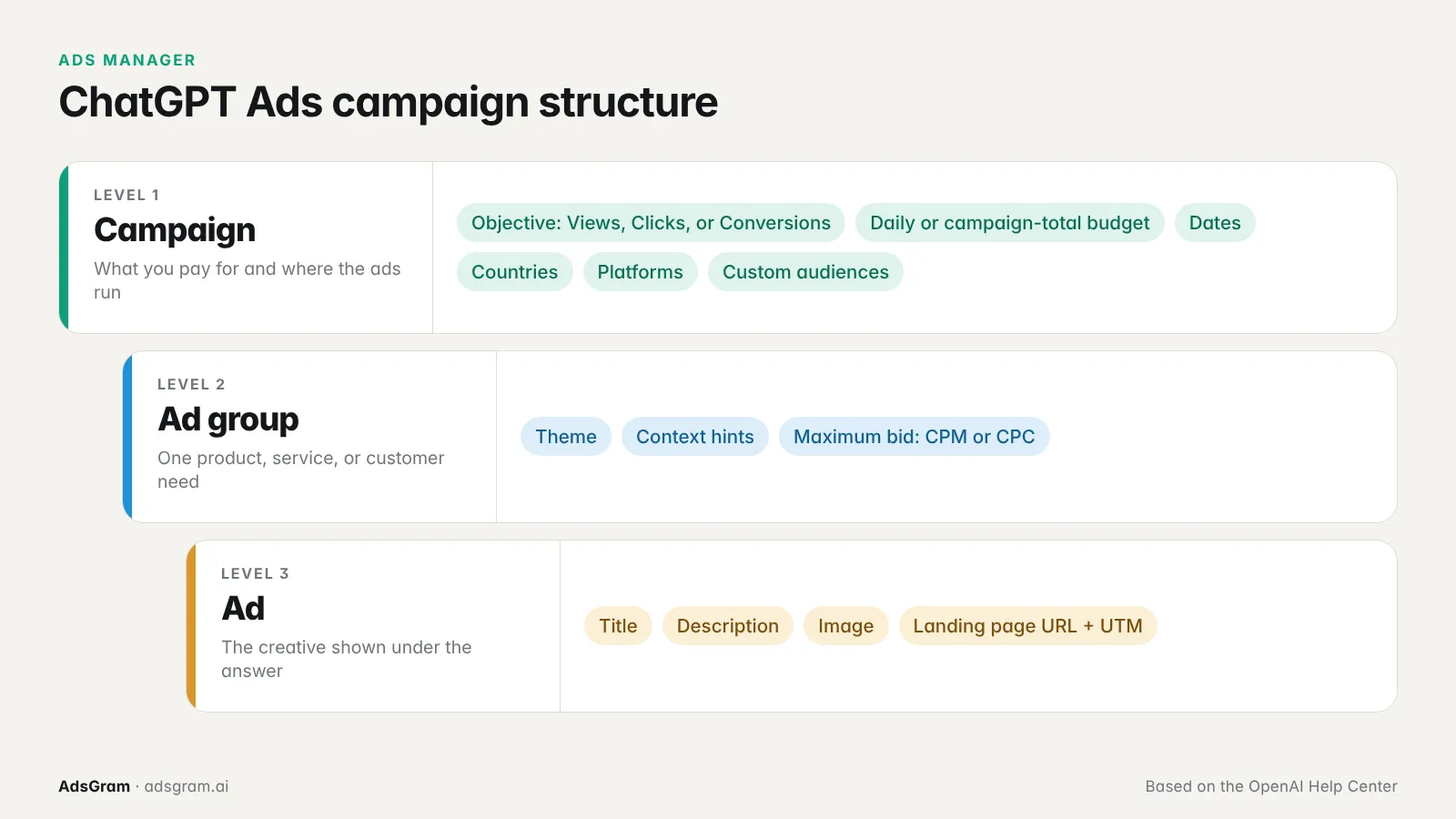
To run ChatGPT ads, you build three levels in Ads Manager: a campaign, an ad group, and an ad. Then you submit the ads for review. The campaign defines the objective, budget, dates, and targeting. The ad group holds a theme, context hints, and a bid. The ad is the creative.
- Set up measurement first. Install the OpenAI Pixel, connect the Conversions API, or use both for more resilient tracking. For mobile apps, connect a mobile measurement partner: Adjust, Airbridge, AppsFlyer, Branch, Kochava, Singular, and Tenjin are supported. Add UTM parameters to every landing page URL.
- Create a campaign and choose an objective. The options are Views, Clicks, and Conversions. For a first test, start with Clicks: it shows the cost of a visit before you have enough conversions to optimize for. The Conversions objective needs at least one standard conversion event from your Pixel or API.
- Set the budget and dates. Choose a daily budget or a campaign-total budget, then the start and end dates.
- Choose targeting. Select the countries to target. You can also limit platforms (Android app, Android web, desktop web, iOS app, iOS web) and add custom audiences. A custom audience for inclusion needs at least 25,000 matched users.
- Create ad groups. Build each ad group around one product, service, or customer need. Add context hints and set a maximum bid: CPM for Views, CPC for Clicks.
- Create ads. Each ad needs a title, a description, an image, and a landing page URL. Make several variations per ad group so the system can test different angles. Keep the landing page open to OpenAI's crawlers, OAI-AdsBot and OAI-SearchBot: OpenAI uses them to validate and review the page.
- Submit and launch. Ads go live once they pass review. Impressions and clicks refresh about every 15 minutes, and spend data can lag by 7–8 hours, so do not judge spend in the first hours.
How to Write Context Hints for ChatGPT Ads
A context hint is a natural phrase about one idea: what you offer, who it helps, or when it is useful. OpenAI's guidance asks for hints that add information beyond the ad and the landing page.
Weak context hint | Strong context hint |
|---|---|
running shoes, sneakers, buy shoes | Cushioned everyday running shoes for beginners training for their first 5K |
plumber, plumbing services | After-hours residential plumbing in [city], with an $89 service-call fee for urgent repairs |
accounting software | Bookkeeping software for growing retailers that need to reconcile online and in-store sales |
The examples in the right column come from OpenAI's guide to context hints.
How to Create Ads With ChatGPT
You can create ads with ChatGPT itself through the ChatGPT Ads Manager plugin. The plugin connects ChatGPT to the Ads Manager accounts you have access to, so you manage campaigns in plain language.
What the plugin does:
- drafts an ad title and description from your website or a brief;
- creates one ad or a set of up to 50 variants per request;
- generates images or reuses eligible existing creative;
- pauses, activates, and archives campaigns, ad groups, and ads, with your approval before each change;
- reviews performance: impressions, clicks, spend, CTR, average CPC and CPM, and conversions.
What still has to be done in Ads Manager: billing, payment methods, tax details, legal identity, and appeals.
The same approach works for other channels: ask ChatGPT to rewrite the winning message for a different limit. A Telegram Ads sponsored message, for example, fits into 160 characters.
ChatGPT Ads Policies and Restrictions
Every ChatGPT ad is checked against OpenAI's ad policies before it runs. Some categories are prohibited outright, and several regulated categories are allowed only in the US and under extra conditions.
Status | Categories |
|---|---|
Prohibited | Adult content, alcohol and tobacco, gambling, political content, recreational drugs, counterfeit goods, unsubstantiated wellness claims |
US only, case-by-case approval | Financial services, health services |
US only, licensed attorneys | Legal services |
Three requirements apply to every ad: claims must be truthful, the ad must not look like part of the ChatGPT interface, and the landing page must clearly relate to the advertiser and the offer.
If an ad is rejected, use the appeal option or the Request Review button in Ads Manager. OpenAI calls an appeal the fastest path to a resolution.
Common ChatGPT Ads Setup Mistakes
Most ChatGPT ads setup mistakes come from carrying over habits from search and social platforms. These four cost the most in the first weeks.
- Writing context hints as keyword lists. Hints are read as descriptions. A string of disconnected words adds almost nothing to relevance.
- Blocking OpenAI's crawlers. If robots.txt or a firewall closes the landing page to OAI-AdsBot, the page cannot be validated and the ad can fail review.
- Launching Conversions without events. The objective requires a configured standard event. Custom conversion events are not supported yet.
- Putting everything into one ad group. Mixed themes blur relevance, and you cannot see which customer need drives the clicks.
ChatGPT Ads and Telegram Ads Together
ChatGPT ads and Telegram Ads solve different tasks in one funnel. ChatGPT catches a person at the moment of choice. Telegram builds reach and repeat touches in the channels that person reads every day.
Telegram has over 1 billion active users. Telegram Ads is the messenger's official ad platform: sponsored messages in channels, bots, and search. AdsGram is an advertising platform and an official Telegram Ads reseller, so these campaigns launch from an AdsGram account.
How to combine the two channels:
- Find the working message in ChatGPT. Run several ad groups with the Clicks objective and see which customer need gets the clicks.
- Move the winning message to Telegram. Cut it to 160 characters and target channels on the same topics.
- Compare the channels by cost per conversion. Use one UTM scheme for both, so the numbers land in the same report.
When Telegram Ads is the better first channel:
- Your legal entity is outside the Ads Manager country list.
- Your category is restricted in ChatGPT. Financial services, for example, are approved case by case and only in the US.
- You need broad reach in a specific language or country, not only the people who are asking an AI assistant right now.
Terms for Telegram Ads through AdsGram:
- Campaign types. Users and Channels are available from the start. Bots and Search unlock after the first freeze in Users or Channels.
- Entry threshold. The daily budget starts at 10 USDT. The first campaign in a new region or language reserves 500 USDT on the balance.
- Other placements. Beyond Telegram Ads, AdsGram runs campaigns in Telegram Mini Apps, channels, and bots with CPM, tCPC, and tCPA pricing.
- Analytics. Integrations with AppsFlyer, Adjust, AppMetrica, Keitaro, and Kochava. Campaign setup takes about five minutes.
For an overview of the platform, see advertising in Telegram. Before writing ad copy, check the Telegram Ads requirements.
FAQ
- How do I run ads on ChatGPT? To run ads on ChatGPT, create an account at ads.openai.com, complete business verification, and add a payment card. Then build a campaign with an objective and budget, an ad group with context hints and a bid, and an ad with a title, description, image, and landing page. Ads start delivering after they pass review.
- How much do ChatGPT ads cost? ChatGPT ads cost from $25 a day, the minimum daily budget for US dollar accounts, with no minimum commitment in self-serve. The auction sets the actual price. OpenAI recommends a starting bid of $3–$5 per click, and reported CPMs range from $25 to $60. Official performance benchmarks have not been published.
- What do ChatGPT ads look like? ChatGPT ads look like a compact card below the assistant's answer. The card carries a "Sponsored" label, the advertiser's name and favicon, a short title, a description, an image, and a link. Retail advertisers can also show product cards with a price and rating. Ads are visually separated from the answer itself.
- How do ChatGPT ads work? ChatGPT ads work through contextual matching and an auction. The system evaluates the context and intent of a conversation, selects eligible ads, and ranks them by relevance and bid in a second-price auction. The winning ad appears below the answer. Ads do not change the answer, and advertisers do not see conversations.
- How do I sign up for ChatGPT ads? To sign up for ChatGPT ads, go to ads.openai.com and log in with your OpenAI account or create one. Enter the advertiser name, country, currency, and time zone, then complete business verification and add a credit card. Your legal entity must be based in a country where Ads Manager is available.
- Where is the ChatGPT Ads Manager login? The ChatGPT Ads Manager login is at ads.openai.com. There is no separate advertiser login: you sign in with the same OpenAI account you use for ChatGPT. Access inside an ad account depends on your role: Admin, Member, or Viewer. One user can belong to several ad accounts.
- Is it free to advertise on ChatGPT? Advertising on ChatGPT is not free, but opening an Ads Manager account costs nothing and there is no minimum commitment. You pay only for delivered impressions or clicks, starting from a $25 daily budget. The free alternative is organic visibility: ChatGPT can mention a brand in its answers without any payment.
- Can ChatGPT create ads for me? ChatGPT can create ads through the ChatGPT Ads Manager plugin. It drafts titles and descriptions from your website or brief, builds up to 50 ad variants per request, and can generate images. Changes to campaigns need your approval. Billing, verification, and appeals are still handled directly in Ads Manager.